Worked solution
A parameter in the denominator
Given that is a positive real number, solve the inequality , leaving your answer in terms of .
[2013/HCI/I/1]
CJC · Discussion · Question 7
Answer
.
Complete the square and factor
The numerator is , strictly positive for every real input. The denominator factors as . It therefore suffices to solve .
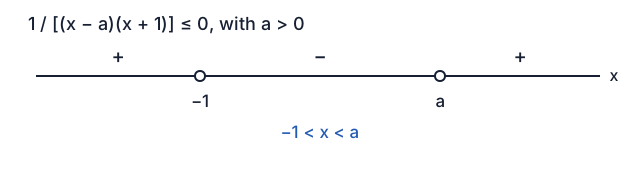
Sign chart
Since , the poles are ordered . The signs are positive, negative, positive in the three intervals. The numerator never vanishes and both poles are excluded. Hence .
Compare your sketch
Expand diagramFit diagram to page
Use the scrollbars or arrow keys to inspect details.
Common mistakes
The non-strict inequality still gives open endpoints because neither pole is in the domain.
Solution notes
The solution diagrams are independently drawn from the printed mathematical relationships. Geometry is illustrative; use the labelled critical values and endpoint symbols.