Worked solution
Use equal vectors and diagonal lengths to identify a quadrilateral
Referred to an origin , the position vectors of four non-collinear points , , and are , , and respectively. Given that , show that is a parallelogram.
Given also that , identify the shape of the parallelogram , justify your answer.
[N2004/I/3]
CJC · Discussion · Question 2
Answer
is a parallelogram; the equal-diagonal condition makes it a rectangle.
Show the parallelogram property
and . Their equality means these opposite sides have the same length and direction. Hence one pair of opposite sides is equal and parallel, so the nondegenerate quadrilateral is a parallelogram.
Use the extra magnitude condition
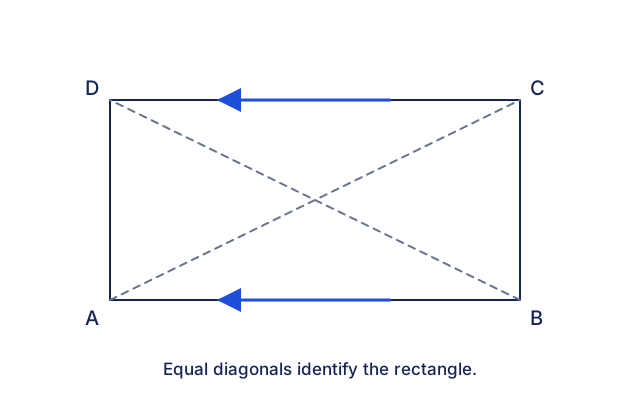
says : the diagonals of the parallelogram have equal lengths. A parallelogram with equal diagonals is a rectangle. The comparison figure illustrates this final special case; the printed generic parallelogram sketch supplies the same vertex and arrow relationships.
Compare your sketch
Expand diagramFit diagram to page
Use the scrollbars or arrow keys to inspect details.
Common mistakes
The second given condition equates magnitudes, not the two diagonal vectors. Losing the bars changes the mathematical problem.
Solution notes
The printed sketch is a generic slanted parallelogram; the independent diagram illustrates the final rectangle while retaining vertex order, both diagonals and B→A/C→D arrows. No lengths are inferred from the printed drawing.