Porisma

Worked solution

Apply the section formula and preserve vertex order

The position vectors of vertices AA, BB and CC, relative to the origin OO, are −3i+4k-3\mathbf i+4\mathbf k, −2i+4j−3k-2\mathbf i+4\mathbf j-3\mathbf k and 11i−4j−9k11\mathbf i-4\mathbf j-9\mathbf k respectively.

(i) Find a unit vector parallel to OA→\overrightarrow{OA}.

(ii) A point PP divides ACAC in the ratio 1:31:3. Find the position vector of PP.

(iii) Show that the points OO, BB and PP are collinear.

(iv) OBDCOBDC forms a parallelogram. Find the position vector of DD.

[2010/RVHS/Promo/6]

CJC · Discussion · Question 3

Answer

(i) 15(−3,0,4)\frac 15(-3,0,4); (ii) OP→=(12,−1,34)\overrightarrow{OP}=(\frac 12,-1,\frac 34); (iii) OP→=−14OB→\overrightarrow{OP}=-\frac 14\overrightarrow{OB}; (iv) OD→=(9,0,−12)\overrightarrow{OD}=(9,0,-12).

(i) Normalise OA

∣OA→∣=(−3)2+42=5|\overrightarrow{OA}|=\sqrt{(-3)^2+4^2}=5. One unit vector parallel to it is 15(−304)\frac 15\begin{pmatrix}-3\\0\\4\end{pmatrix}. Its negative is also parallel, in the opposite orientation; the source gives the positive-direction choice.

How did this part go?

(ii) Divide AC internally

With AP:PC=1:3AP:PC=1:3,

OP→=3OA→+OC→4=(12−134).\overrightarrow{OP}=\frac{3\overrightarrow{OA}+\overrightarrow{OC}}4=\begin{pmatrix}\frac 12\\-1\\\frac 34\end{pmatrix}.

The endpoint nearer P receives the larger opposite weight.

How did this part go?

(iii) Compare OB and OP

OP→=−14OB→\overrightarrow{OP}=-\frac 14\overrightarrow{OB}, since OB→=(−2,4,−3)\overrightarrow{OB}=(-2,4,-3). The vectors are parallel and both start at O, so O, B and P are collinear. The negative multiple places P on the opposite side of O from B.

How did this part go?

(iv) Complete the specified parallelogram

In the order O–B–D–C, BD→=OC→\overrightarrow{BD}=\overrightarrow{OC}. Thus

OD→=OB→+OC→=(90−12).\overrightarrow{OD}=\overrightarrow{OB}+\overrightarrow{OC}=\begin{pmatrix}9\\0\\-12\end{pmatrix}.

The independent schematic retains this order and the equal directed sides.

How did this part go?

Compare your sketch

Expand diagram

Use the scrollbars or arrow keys to inspect details.
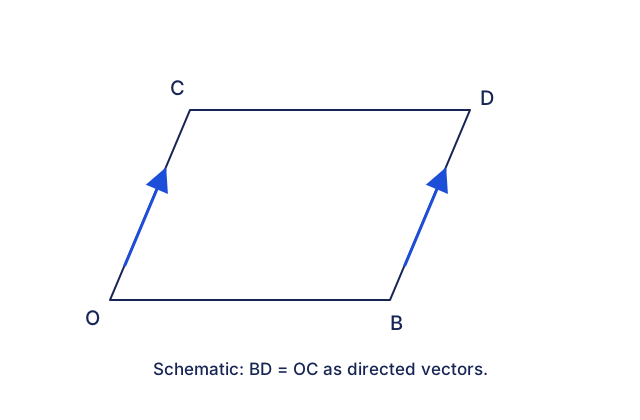
Schematic parallelogram OBDC: O bottom left, B bottom right, D top right, C top left. The equal vectors O to C and B to D are marked. This is a labelled schematic, not a projection of the three-dimensional coordinates.

Common mistakes

OBDC has D opposite O. It is not the same ordering as OBCD.

Solution notes

All four printed asks retained. The source diagram is schematic; the redrawing is explicitly not a coordinate projection. A parallel unit-vector answer is not unique unless orientation is specified.

Read the hint