Porisma

Worked solution

Solve perpendicularity conditions and compare two area methods

The points AA, BB, CC and DD have position vectors i−2j+5k\mathbf i-2\mathbf j+5\mathbf k, i+3j\mathbf i+3\mathbf j, 10i+j+2k10\mathbf i+\mathbf j+2\mathbf k and −2i+4j+5k-2\mathbf i+4\mathbf j+5\mathbf k respectively, with respect to an origin OO. The point PP on ABAB is such that AP:PB=λ:1−λAP:PB=\lambda:1-\lambda and the point QQ on CDCD is such that CQ:QD=μ:1−μCQ:QD=\mu:1-\mu. Find OP→\overrightarrow{OP} and OQ→\overrightarrow{OQ} in terms of λ\lambda and μ\mu respectively.

Given that PQ→\overrightarrow{PQ} is perpendicular to both AB→\overrightarrow{AB} and CD→\overrightarrow{CD},

(i) show that PQ→=i+2j+2k\overrightarrow{PQ}=\mathbf i+2\mathbf j+2\mathbf k,

(ii) find the area of the triangle ABQABQ.

[2006/I/14(OR)]

CJC · Discussion · Question 11

Answer

OP=(1,5λ−2,5−5λ)OP=(1,5\lambda-2,5-5\lambda); OQ=(10−12μ,3μ+1,3μ+2)OQ=(10-12\mu,3\mu+1,3\mu+2). λ=3/5\lambda=3/5, μ=2/3\mu=2/3, PQ=(1,2,2)PQ=(1,2,2); area 152/215\sqrt 2/2.

Parameterise both points

The section formula gives

OP→=λOB→+(1−λ)OA→=(15λ−25−5λ),\overrightarrow{OP}=\lambda\overrightarrow{OB}+(1-\lambda)\overrightarrow{OA}=\begin{pmatrix}1\\5\lambda-2\\5-5\lambda\end{pmatrix},

and

OQ→=μOD→+(1−μ)OC→=(10−12μ3μ+13μ+2).\overrightarrow{OQ}=\mu\overrightarrow{OD}+(1-\mu)\overrightarrow{OC}=\begin{pmatrix}10-12\mu\\3\mu+1\\3\mu+2\end{pmatrix}.

How did this part go?

(i) Use the first perpendicularity equation

Subtract the position vectors:

PQ→=(9−12μ3−5λ+3μ−3+5λ+3μ).\overrightarrow{PQ}=\begin{pmatrix}9-12\mu\\3-5\lambda+3\mu\\-3+5\lambda+3\mu\end{pmatrix}.

Since AB→=(0,5,−5)\overrightarrow{AB}=(0,5,-5), the equation PQ⋅AB=0PQ\cdot AB=0 is

5(3−5λ+3μ)−5(−3+5λ+3μ)=0.\begin{aligned}&5(3-5\lambda+3\mu)-5(-3+5\lambda+3\mu)\\ & =0.\end{aligned}

This gives λ=3/5\lambda=3/5.

How did this part go?

(i) Use the second perpendicularity equation

CD→=(−12,3,3)\overrightarrow{CD}=(-12,3,3). Hence PQ⋅CD=0PQ\cdot CD=0 gives

−12(9−12μ)+3(3−5λ+3μ)+3(−3+5λ+3μ)=0.\begin{aligned}&-12(9-12\mu)+3(3-5\lambda+3\mu)\\ &{}+3(-3+5\lambda+3\mu)\\ & =0.\end{aligned}

It simplifies to −108+162μ=0-108+162\mu=0, so μ=2/3\mu=2/3. Substitution gives PQ→=(1,2,2)\overrightarrow{PQ}=(1,2,2), as required. In particular P=(1,1,2)P=(1,1,2) and Q=(2,3,4)Q=(2,3,4).

How did this part go?

(ii) Source method 1: cross product

AQ→=Q−A=(1,5,−1)\overrightarrow{AQ}=Q-A=(1,5,-1) and AB→=(0,5,−5)\overrightarrow{AB}=(0,5,-5). Therefore

AB→×AQ→=5(4−1−1),\overrightarrow{AB}\times\overrightarrow{AQ}=5\begin{pmatrix}4\\-1\\-1\end{pmatrix},

and

area(ABQ)=12∣AB×AQ∣=5218=1522.\begin{aligned}&\text{area}(ABQ)\\ & =\frac 12|AB\times AQ|\\ & =\frac 52\sqrt{18}\\ & =\frac{15\sqrt 2}{2}.\end{aligned}

How did this part go?

(ii) Source method 2: base and altitude

P lies on AB and PQ is perpendicular to AB, so PQ is the altitude from Q. The lengths are ∣AB∣=50|AB|=\sqrt{50} and ∣PQ∣=9=3|PQ|=\sqrt 9=3. Thus

area(ABQ)=1250(3)=1522.\begin{aligned}&\text{area}(ABQ)\\ & =\frac 12\sqrt{50}(3)\\ & =\frac{15\sqrt 2}{2}.\end{aligned}

Both source triangle figures are represented in the two comparison panels.

How did this part go?

Compare your sketch

Expand diagram

Use the scrollbars or arrow keys to inspect details.
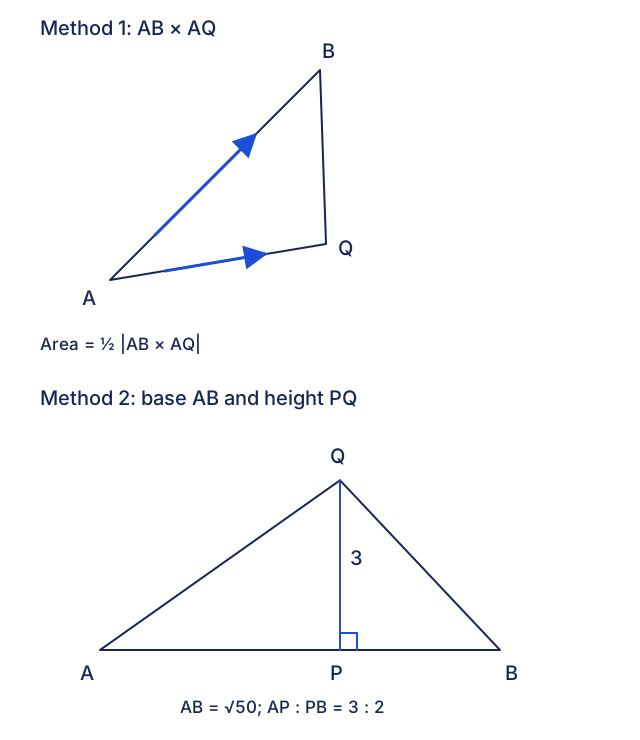
Two labelled panels. First, triangle ABQ with directed edges AB and AQ for the cross-product method, shown schematically. Second, AB is horizontal, P lies 60 percent from A to B, PQ is perpendicular to AB, and Q is above P; lengths AB = √50 and PQ = 3 give the altitude method.

Common mistakes

The initial requests for OP and OQ come before numbered part (i); they are still part of the printed problem and must be answered.

Solution notes

Full unnumbered opening asks, both perpendicularity equations and both area methods on PDF 10–12 retained. Two source triangle diagrams are reconstructed in one accessible two-panel SVG; the second panel preserves the internal-foot geometry and actual AP:PB=3:2 ratio.

Read the hint