Algebra readiness
← Back to learning units · Complete chapter reading and print view · Open reference notes separately
By the end, you can
- Refresh equations, powers and logarithms
- Complete the square and use the factor theorem
- Recognise partial fractions, trigonometry and basic calculus
about an hour for the lesson · practise at your own pace.
The central idea
Equivalent algebraic forms reveal different information. Factoring finds zeros, completing the square exposes a quadratic vertex, and logarithms turn multiplication into addition. Keep the number system and domain in view: denominators cannot vanish and real logarithms need positive arguments.
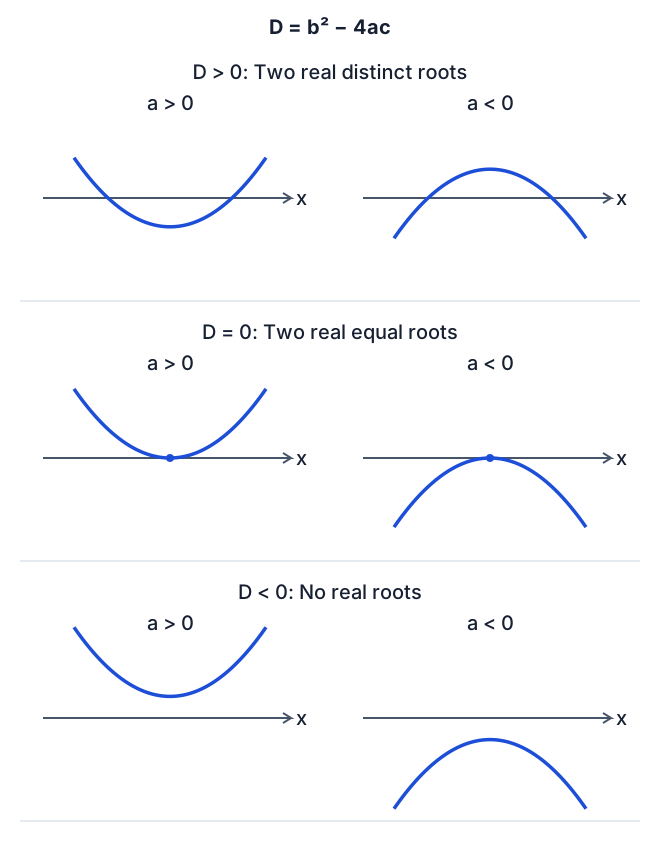
Six discriminant and leading-coefficient cases
How roots and opening fit together
D = 4: two distinct real roots. The curve crosses the axis at −1 and 1.
Read a quadratic in two checks
- Check the discriminant.
- Count the real roots.
- Use the opening to decide signs.

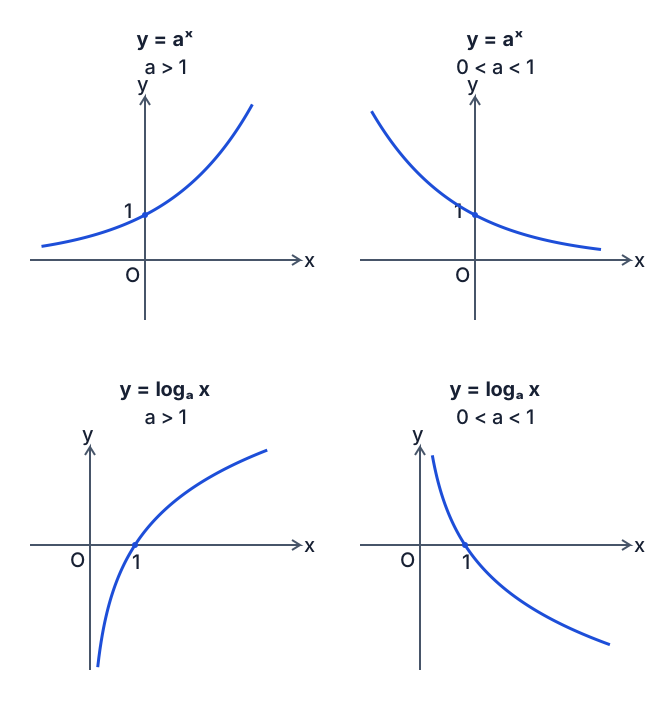
Exponential and logarithm graphs for both base ranges
Compare exponentials and logarithms
Domain: all real inputs. Range: y > 0. The curve increases; y = 0 is a horizontal asymptote, never an attained value.
Choose an exponential or logarithm method
- Check the base and domain.
- Rewrite using a common base or logarithms.
- Check answers in the original equation.

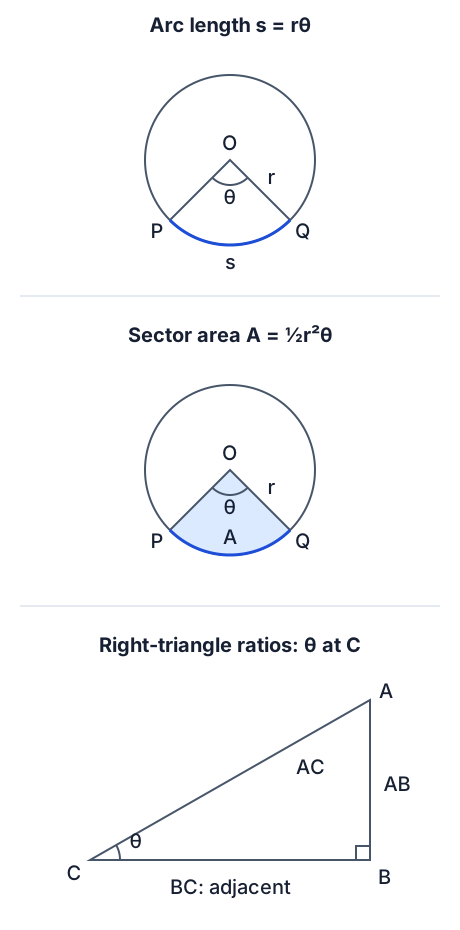
Circular measure and right-triangle ratios
Illustration: r = AC = 3 units.
Arc length
The highlighted arc PQ subtends θ at centre O.
s ≈ 2.3562 units.
Sector area
The shaded region is sector POQ, with area A.
A ≈ 3.5343 square units.
Right-triangle ratios
The right angle is at B; the acute angle θ is at C. AB is opposite, BC adjacent and AC the hypotenuse.
AB ≈ 2.1213, BC ≈ 2.1213, AC = 3 units.
- ≈ 0.7071
- ≈ 0.7071
- ≈ 1
Compare with the original three panels
Expand diagramFit diagram to page
Use the scrollbars or arrow keys to inspect details.
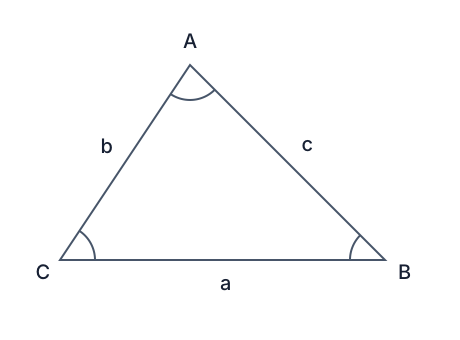
General triangle side and angle names
Match a lowercase side with the opposite uppercase angle. These rules apply to general triangles; no right angle is assumed.
Match opposite sides and angles
- Opposite angle A
- Opposite angle B
- Opposite angle C
Cosine rule: use the included angle
Use two sides and their included angle, or use all three sides to find an angle. Choose the form with the required side opposite its matching angle.
For side a, opposite A
For side b, opposite B
For side c, opposite C
Sine rule: keep each opposite pair together
If inverse sine gives an angle, check whether its supplementary angle also satisfies the triangle's other data.
Compare with the original naming sketch
Expand diagramFit diagram to page
Use the scrollbars or arrow keys to inspect details.
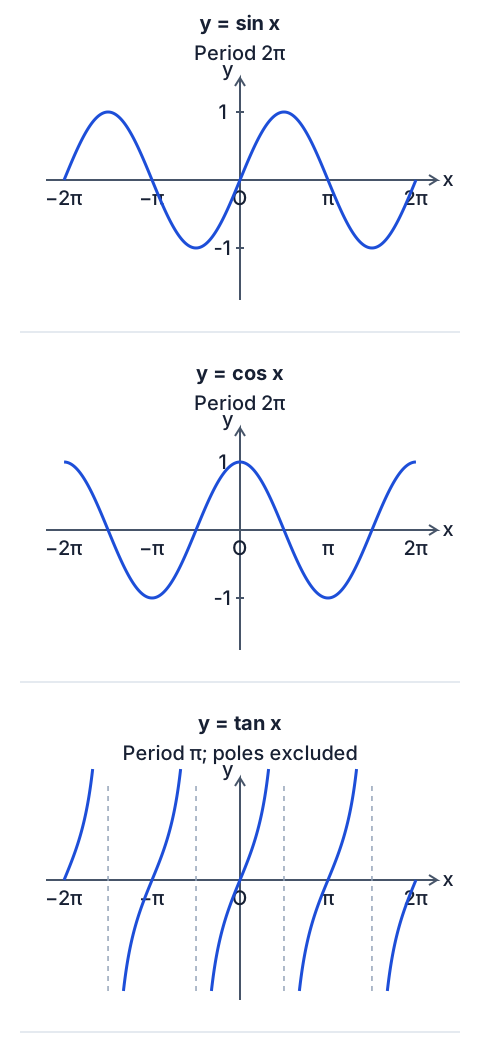
Sine cosine and tangent graphs
Read one trigonometric graph at a time
Domain: all real inputs. Range: [−1, 1]. Period: 2π. Sine is odd: sin(−x) = −sin x.
Read a trigonometric graph
- Choose the function and interval.
- Mark intercepts and excluded poles.
- Use the period to repeat the pattern.

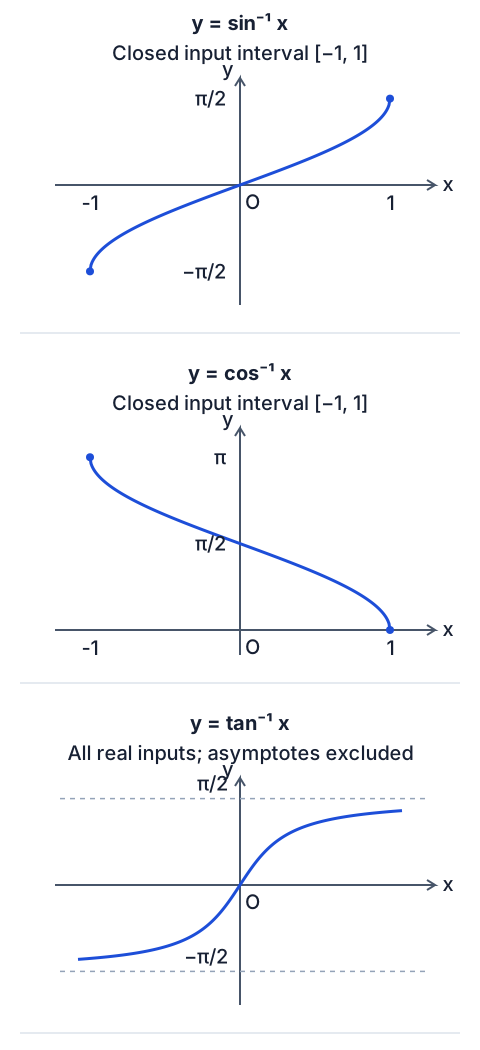
Principal inverse-trigonometric graphs
See the principal angle range
Domain: [−1, 1]. Principal range: [−π/2, π/2]. Increasing, with both endpoints included.
Choose a principal inverse value
- Check the inverse function domain.
- Find the angle in its principal range.
- Check by applying the original function.

Explore
Use the worked example below, then change one input or assumption. Predict which part of the answer must change before calculating.
Related interactive example
Explore this related example, then return to the prediction task above.
Worked example
Solve . Completing the square gives , hence or . The same expression is ; its vertex form also shows that its minimum is at .
Squaring can introduce candidates that do not satisfy the original equation.
Check your understanding
Solve over the real numbers.
The equation requires . Squaring gives , so candidates are 2 and −1. Only satisfies both the domain and the original equation.
Practice questions
Practice section 1 · Questions 1–6
Complete the square with and without a leading coefficient · Solve a reciprocal equation using the quadratic formula · +4 more
Practice section 2 · Questions 7–12
Apply fractional and negative index laws · Use a positive exponential substitution · +4 more
Practice section 3 · Questions 13–18
Include both powers of a repeated linear factor · Combine a linear factor with an irreducible quadratic · +4 more
Practice section 4 · Questions 19–24
Control the square-root sign in a trigonometric substitution · Prove the triple-angle cosine identity · +4 more
Practice section 5 · Questions 25–30
Use the requested product rule · Keep the quotient-rule numerator order · +4 more
Practice section 6 · Questions 31–36
Complete the square · Find exact quadratic roots · +4 more
Practice section 7 · Questions 37–42
Simplify fractional indices · Solve with a common exponential base · +4 more
Practice section 8 · Questions 43–47
Prove a fourth-power trigonometric identity · Combine sine and cosine to prove bounds · +3 more
More practice
Ready to try this on your own?
For “Algebra readiness”, try a question without the working and explain your method. This records your confidence, saved in this browser only.