Porisma
Back to reading

Algebra readiness

Use radians and triangle ratios · Diagrams · Complete reading

Choose another diagram

Circular measure and right-triangle ratios

Illustration: r = AC = 3 units.

Acute angle θ45° = π/4 rad
Try an example

Arc length

s=rθs=r\theta

θ in radians
OPQrθs

The highlighted arc PQ subtends θ at centre O.

s ≈ 2.3562 units.

Sector area

A=12r2θA=\tfrac12r^2\theta

θ in radians
OPQrθ

The shaded region is sector POQ, with area A.

A ≈ 3.5343 square units.

Right-triangle ratios

The right angle is at B; the acute angle θ is at C. AB is opposite, BC adjacent and AC the hypotenuse.

ABCABBCACθ

AB ≈ 2.1213, BC ≈ 2.1213, AC = 3 units.

sin⁡θ=ABAC\sin\theta=\dfrac{AB}{AC}

≈ 0.7071

cos⁡θ=BCAC\cos\theta=\dfrac{BC}{AC}

≈ 0.7071

tan⁡θ=ABBC\tan\theta=\dfrac{AB}{BC}

≈ 1

Compare with the original three panels

Expand diagram

Use the scrollbars or arrow keys to inspect details.
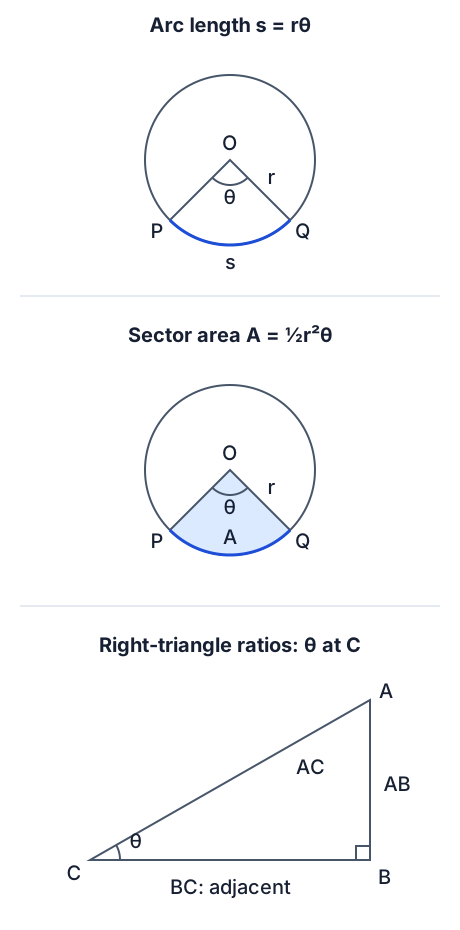
Three source panels: circle with centre O, radius r, angle theta and arc PQ length s; separate circle with sector POQ area A; right triangle ABC with right angle B and acute theta at C, opposite AB, adjacent BC and hypotenuse AC.
Open original diagram (new tab)

General triangle side and angle names

Match a lowercase side with the opposite uppercase angle. These rules apply to general triangles; no right angle is assumed.

ABCabc
Each side is opposite its matching angle. The sketch supplies no side lengths.

Match opposite sides and angles

Opposite angle A

a=BCa=BC

Opposite angle B

b=CAb=CA

Opposite angle C

c=ABc=AB

Cosine rule: use the included angle

Use two sides and their included angle, or use all three sides to find an angle. Choose the form with the required side opposite its matching angle.

For side a, opposite A

a2=b2+c2−2bccos⁡A.\begin{aligned}a^2&=b^2+c^2\\&\quad-2bc\cos A.\end{aligned}

For side b, opposite B

b2=a2+c2−2accos⁡B.\begin{aligned}b^2&=a^2+c^2\\&\quad-2ac\cos B.\end{aligned}

For side c, opposite C

c2=a2+b2−2abcos⁡C.\begin{aligned}c^2&=a^2+b^2\\&\quad-2ab\cos C.\end{aligned}

Try the included-angle example

Sine rule: keep each opposite pair together

sin⁡Aa=sin⁡Bb=sin⁡Cc.\begin{aligned}\frac{\sin A}{a}&=\frac{\sin B}{b}\\&=\frac{\sin C}{c}.\end{aligned}

If inverse sine gives an angle, check whether its supplementary angle also satisfies the triangle's other data.

Compare with the original naming sketch

Expand diagram

Use the scrollbars or arrow keys to inspect details.
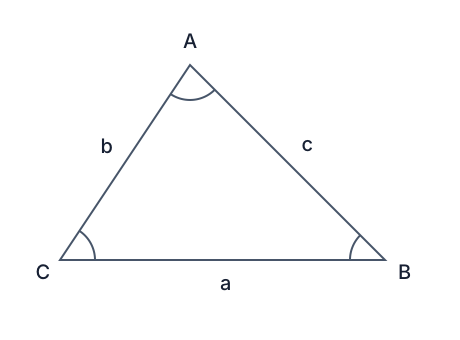
General triangle ABC has angle labels A,B,C and opposite sides a=BC,b=CA,c=AB. No right angle is assumed.
Open original diagram (new tab)
Back to reading