Porisma
Back to reading

Complex numbers and the Argand plane

Read complex numbers in the plane · Diagrams

Choose another diagram

Point, position vector and direction in the Argand plane

Illustration: one complex number as a point and a position vector.

z = 1 + 3i

Grid spacing is 1 unit. P = (1, 3). The arrow OP has components (1, 3); its length is |z|.

Real coordinate x1
Imaginary coordinate y3
Try an example

z=x+iyz=x+iy

OP→=(xy)\overrightarrow{OP}=\begin{pmatrix}x\\y\end{pmatrix}

Real part x
1
Imaginary part y
3
Modulus |z|
≈ 3.1623
Principal argument θ
≈ 1.249 rad

The imaginary part is the real number y, not iy. A point and its position vector describe the same two coordinates.

Directions use −π < θ ≤ π, measured from the positive real axis. Anticlockwise is positive; clockwise is negative.

Compare with the three source views

Expand diagram

Use the scrollbars or arrow keys to inspect details.
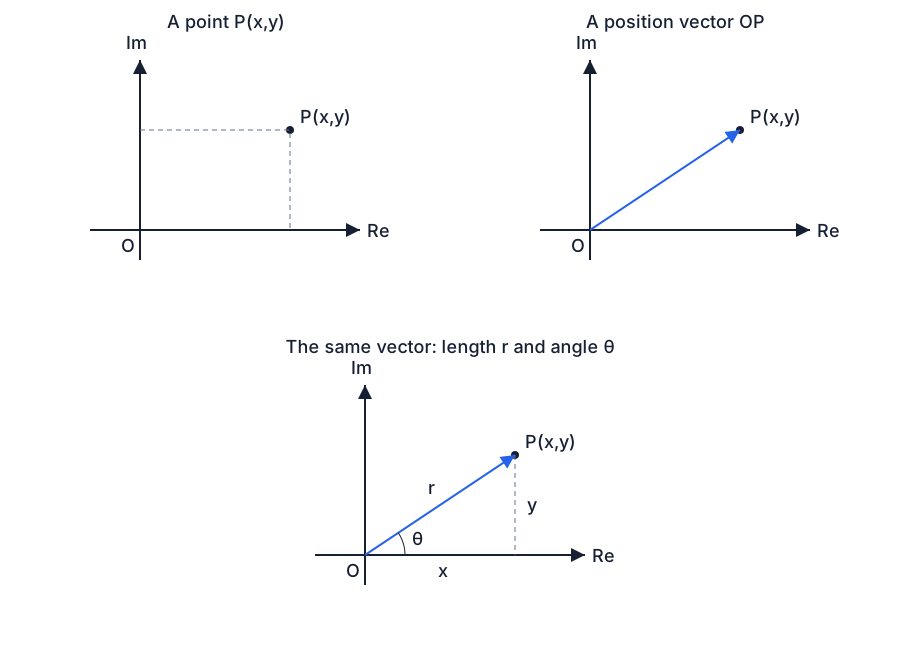
Three source views use the same first-quadrant point P(x,y). First shows dashed real/imaginary projections, second shows position vector OP, third labels its length r, its angle theta from the positive real axis and the x/y components. All axes are labelled Re and Im.
Open original diagram (new tab)
Back to reading