Connect the themes and big ideas
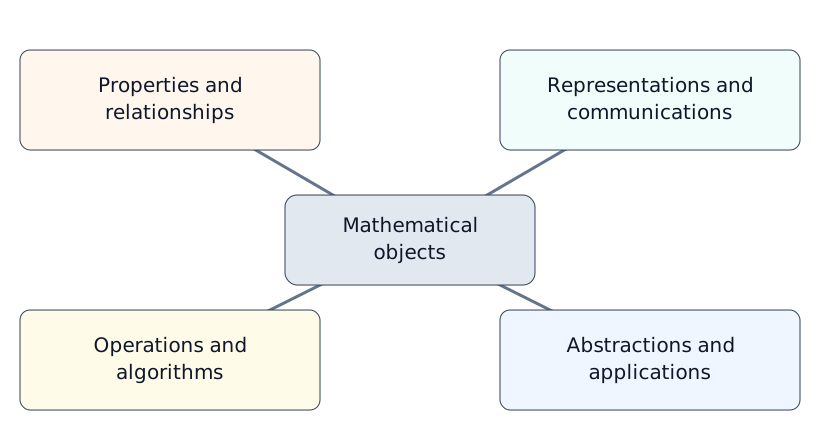
The source’s four recurring themes all connect to mathematical objects. Its diagram asks four questions:
- Properties and relationships: What are the properties of mathematical objects and how are they related?
- Operations and algorithms: What meaningful actions can we perform on the objects and how do we carry them out?
- Representations and communications: How can mathematical objects and concepts be represented and communicated?
- Abstractions and applications: How can mathematical objects be further abstracted and where can they be applied?
Properties and relationships
Properties follow from definitions or from logical argument and rigorous proof. Relationships include equivalent expressions or statements, connections between functions, vector equations of lines and planes, and dependence between variables. Understanding them gives insight and supports modelling real situations.
Operations and algorithms
Operations act meaningfully on objects: algebraic manipulation, geometric transformation and operations on functions are examples. Algorithms organise well-defined smaller steps into a general method for performing an operation or solving a problem. Understand both what an operation means and how to carry it out.
Representations and communications
Symbols, notation, graphs, geometrical figures, Venn diagrams and tree diagrams express concepts, properties and operations precisely. Communicating proof and choosing a suitable representation makes an argument understandable to practitioners and a wider audience. Examples include stating null and alternative hypotheses, or using a scatter diagram for a relationship between variables.
Abstractions and applications
Abstraction generalises, extends and synthesises ideas. Algebra generalises arithmetic; complex numbers extend the number system; coordinate geometry connects algebra and geometry. These connections reveal structure. Abstract objects, properties, operations, relationships and representations support applications from counting to modelling real phenomena.
Eight connected big ideas
The source connects ideas across topics, strands and levels, including connections with the 2020 secondary curriculum, and says the ideas will recur throughout the lecture notes. A cluster may connect more than one theme.
| Big idea | Source theme | Meaning and connections |
|---|---|---|
| Functions | Properties and relationships | A rule maps elements between two sets. Verbal, algebraic, tabular and graphical forms can represent it. Functions may have inverses and can be combined. An operation or algorithm can be understood as input, rule and output, useful in programming; inputs and outputs need not be real numbers. An inverse function needs the appropriate one-to-one restriction. |
| Diagrams | Representations and communications | Diagrams represent real or mathematical objects, communicate their properties and relationships, and help solve problems. Read their features and conventions, and understand how they are constructed. |
| Models | Abstractions and applications | Models simplify or approximate objects and phenomena, with assumptions and limitations. They may be deterministic or probabilistic and derived from theory or data. Use them to describe patterns, analyse, predict and make decisions in context. |
| Equivalence | Properties and relationships | Equal mathematical objects can have different expressions, equations or statements. Converting between equivalent forms supports comparison, manipulation and solution algorithms. Preserve domains and conditions when making a conversion. |
| Transformation | Operations and algorithms | A defined rule changes an object such as a graph, equation or random variable. Some properties change and others remain invariant. Relate the transformed object to the original to develop solution methods. |
| Limits | Properties and relationships | Study an object as a parameter approaches a value or infinity. A limit may exist or fail to exist. Both outcomes inform proof, approximation algorithms and local, long-term or large-scale behaviour. |
| Vectors | Representations and communications | Ordered arrays generalise numbers to represent more than one quantity or dimension. They describe geometric points, lines and planes; data sets or polynomials can also have vector representations. |
| Extensions | Abstractions and applications | Widen the applicability of an object, concept or result through further abstraction, generalisation and application. |
CJC · 2025 Introduction · PDF 3, 4, 5 · printed iii, iv, v