Understand, plan, carry out and check
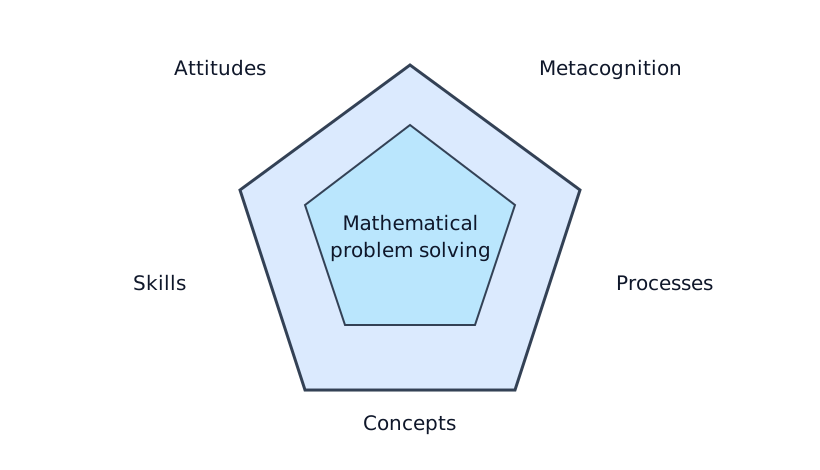
Mathematical problem solving is the centre of the source framework, including curiosity to pose problems and make conjectures. Problems may come from everyday life, future work, other subjects or mathematics itself. Routine tasks call for suitable concepts and skills; non-routine tasks also need insight, reasoning and creativity. Heuristics help organise that work.
Five interrelated supports
- Concepts: Understand objects, properties, relationships, operations and algorithms. Functions and graphs, sequences and series, vectors, calculus, probability and statistics are connected rather than isolated strands.
- Skills: Carry out operations and algorithms fluently; visualise space, handle data and use tools such as spreadsheets and graphing applications. Calculation, estimation, manipulation and simplification recur across problems.
- Processes: Abstract and reason; represent and communicate; apply and model. Derive and justify results, generalise patterns, choose notation for an audience, make reasonable assumptions and simplifications, and interpret and evaluate solutions in their real-world context.
- Metacognition: Be aware of and regulate thinking, select and monitor strategies, and recognise emotional responses to a problem. This matters especially for unfamiliar or open-ended tasks.
- Attitudes: Develop belief in mathematics’ value, appreciation, confidence, motivation, interest and perseverance.
The source diagram places these five supports around problem solving. Its short labels highlight properties/relationships/operations/algorithms for concepts; proficiency, visualisation, data and tools for skills; abstracting/reasoning, representing/communicating and applying/modelling for processes; awareness/monitoring/regulation for metacognition; and belief/appreciation/confidence/motivation/interest/perseverance for attitudes.
Polya’s four stages
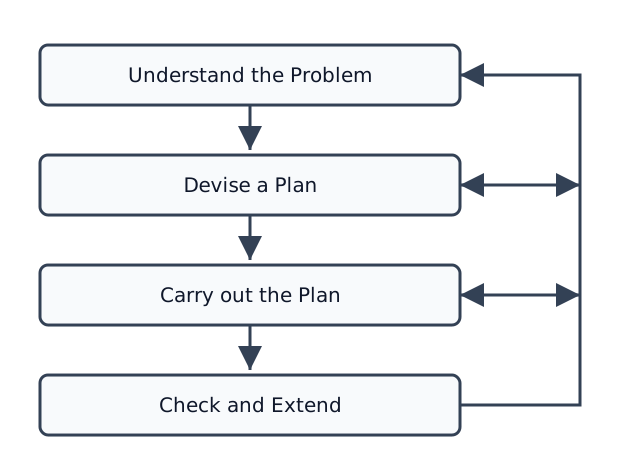
- Understand the Problem: Identify what is given, what is asked and the relevant conditions.
- Devise a Plan: Choose a representation, relationship or method.
- Carry out the Plan: Execute and justify the steps.
- Check and Extend: Verify the result and consider what it tells you or how it generalises.
The stage names and return paths are from the source; the questions below are study prompts. The model permits back-flow: checking can send you back to understanding, planning or carrying out the plan. You can also revisit understanding when planning or carrying out reveals a gap.
Try a study check
Your calculation is consistent, but the answer does not fit the original situation. Which stage should you revisit?
Compare your reasoning
Use Check and Extend to identify the mismatch, then return to Understand the Problem if a condition or modelling assumption was missed. Revise the plan or calculation as needed; the stages permit return paths.
CJC · 2025 Introduction · PDF 6, 7 · printed vi, vii