Review practice · Section 2 of 2
Questions 7–12 in this collection
Take fourth moments when an area is proportional to the square · Respect the first-miss stopping rule before comparing rounds · +4 more
- 7
S has distribution
s 1 0.5 5 0.3 10 0.1 20 0.1 A circle has radius .
(i) Find . marks
(ii) Find and . marks
(iii) Hence find the mean and variance of the circle’s area A. marks
[2006/MJC/II/26]
CJC · Review problems · Question 7
- 8
A fairground game involves shooting at a moving target. A round has a maximum of 3 shots and ends immediately after a miss. Each hit scores 10 points. Linda hits with probability 0.6 on each shot, and all shots taken are independent.
(i) Find the probability that she scores 30 points in a round. marks
X is her score in one round.
(ii) Find its distribution. marks
(iii) Find its mean and variance. marks
(iv) A game consists of two rounds. Find the probability that she scores more in round 2 than round 1. marks
[2017/SAJC/II/8]
CJC · Review problems · Question 8
- 9
A box contains 2 red balls,3 green balls and x blue balls, with integer . A contestant chooses 5 balls without replacement. S is the number of green balls plus three times the number of red balls. Blue balls score nothing unless all 5 balls are blue, in which case S=25.
(i) Show that . marks
(ii) Given , calculate x. marks
(iii) Complete the distribution table. marks
s Given 1 to find 2 3 4 to find 5 6 7 to find 8 9 25 to find (iv) Evaluate and find . marks
(v) Find the probability that no green balls are drawn, given . marks
[2017/CJC/II/10]
CJC · Review problems · Question 9
- 10
Two unbiased regular tetrahedral dice have faces 1,2,3,4. The number on the face in contact with the table is recorded. Tom throws both and notes their total X. Harry guesses the total; his guess is Y. If correct, Harry wins dollars; otherwise he loses dollars.
(i) Obtain the distribution of X and find correct to 3 decimal places. marks
(ii) Harry guesses 6 in a particular game. Find his expected gain. marks
[2006/TJC/II/24]
CJC · Review problems · Question 10
- 11
A board game uses eight-sided dice. The attack die has five faces marked 0, two marked 1 and one marked 2. After the attack throw, the defender throws a defence die with two faces marked 0, four marked 1 and two marked 2. Damage is attack score minus defence score, except that a negative difference gives zero damage.
Let A,D denote the attack and defence scores.
(i) Write down their distributions. Hence find the expectation and variance of . marks
X is the damage in one round.
(ii) Find its distribution, expectation and variance. marks
(iii) Explain why although . mark
[2017/RVHS/II/7]
CJC · Review problems · Question 11
- 12
A player wins by balancing a beam with three alternating items: ball–cube–ball or cube–ball–cube, as shown. An unbiased die determines each item: scores 1 or 2 give a ball; otherwise a cube. The player has at most 5 throws. An item of the same type as the last accepted item is rejected.
Let X be the number of throws required to win. Show that . marks
Find the probability of winning. marks
The entry fee is a dollars. A win on throw 3 pays back 2 a dollars, on throw 4 pays back a/2 dollars, and on throw 5 pays back a/3 dollars. Find a if the owner expects a profit of 1.20 dollars per game. marks
Expand diagramFit diagram to page
Use the scrollbars or arrow keys to inspect details.
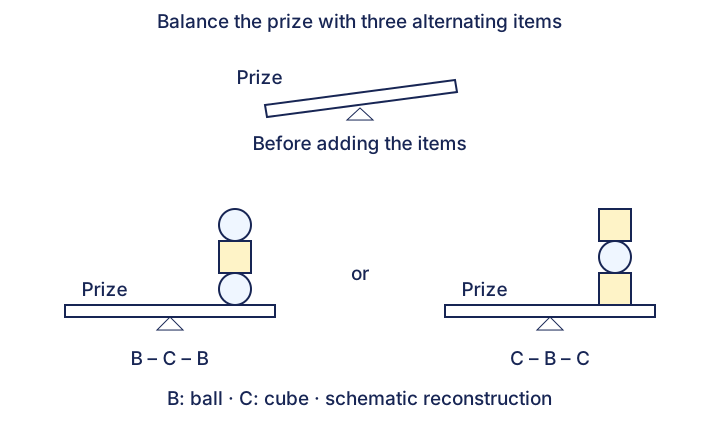
The initial beam is unbalanced. A winning beam has the prize on the left and either ball–cube–ball or cube–ball–cube stacked on the right. Balls are circles; cubes are squares. [2006/NJC/II/29(OR)]
CJC · Review problems · Question 12