Porisma
Back to reading

Probability and conditional information

Probability and conditional information · Diagrams · Complete reading

Choose another diagram

Complement, union and intersection

Expand diagram

Use the scrollbars or arrow keys to inspect details.
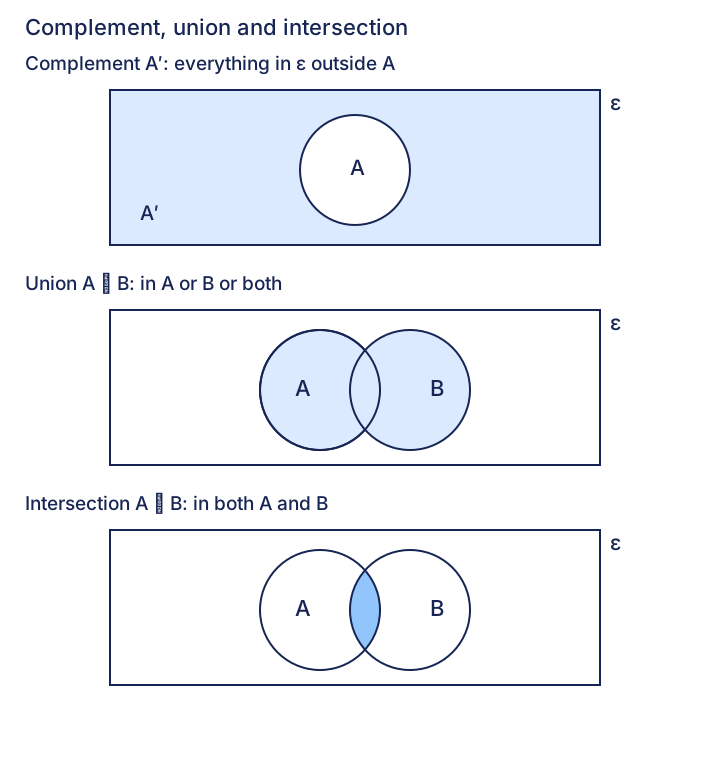
Three source Venn constructions in universal set epsilon. Complement of A shades outside A. Union shades all of both overlapping circles A and B. Intersection shades only their overlap. Geometry and areas are schematic.
Open original diagram (new tab)

Complement, disjointness and conditional reference sets

Expand diagram

Use the scrollbars or arrow keys to inspect details.
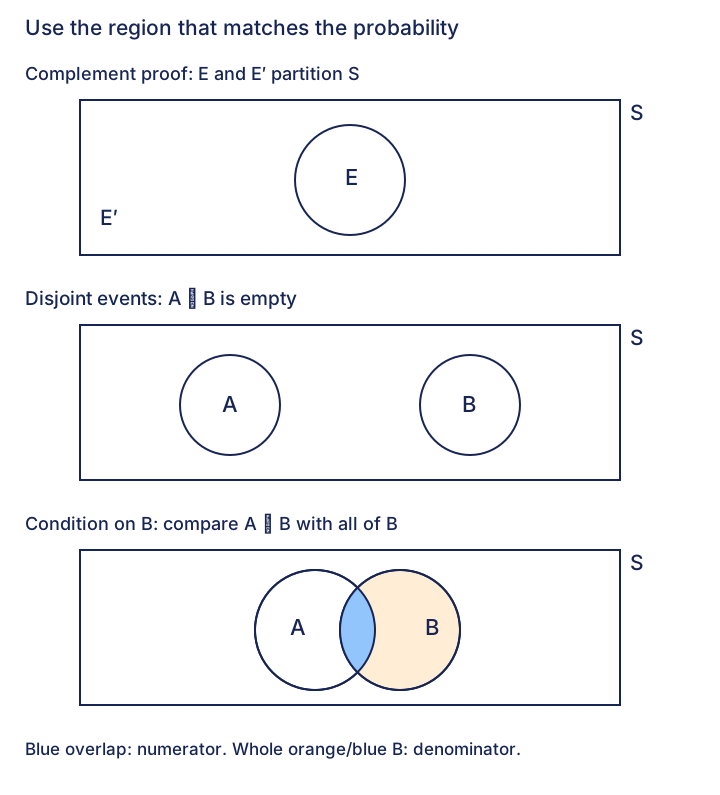
Source proof sketches: E lies in sample space S, with its complement the rest; disjoint A and B have no common outcomes; for conditional probability given B, the entire B region is the reference set and its overlap with A is favourable. Blue marks the intersection and orange marks the rest of B. Areas are schematic, not numerical probabilities. The union double-counting overlap uses the preceding intersection construction.
Open original diagram (new tab)

Read a two-stage probability tree

Explore a probability tree

Choose outcomes, change conditional probabilities, and compare path products with event totals.

Multiply along a complete path; add disjoint complete paths. Each reached split totals 1. Second-stage probabilities are conditional on the first event.

Start branches to A and not-A with probabilitiesP(A),P(not-A). From A branch to B or not-B with conditional probabilitiesP(B|A),P(not-B|A); from not-A branch to B or not-B withP(B|not-A),P(not-B|not-A). Four leaf equations multiply the first probability by its conditional second-stage probability to give each intersection probability. Sibling alternatives are mutually exclusive and exhaustive.
Open original diagram (new tab)
Back to reading