Porisma
Back to reading

Probability and conditional information

Probability and conditional information · Diagrams

Choose another diagram

Complement, disjointness and conditional reference sets

Expand diagram

Use the scrollbars or arrow keys to inspect details.
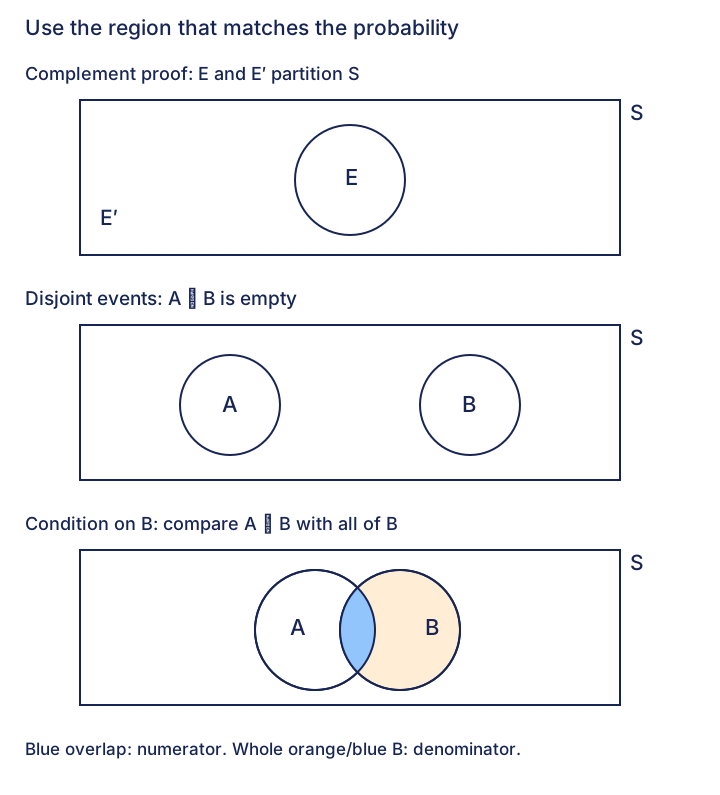
Source proof sketches: E lies in sample space S, with its complement the rest; disjoint A and B have no common outcomes; for conditional probability given B, the entire B region is the reference set and its overlap with A is favourable. Blue marks the intersection and orange marks the rest of B. Areas are schematic, not numerical probabilities. The union double-counting overlap uses the preceding intersection construction.
Open original diagram (new tab)
Back to reading