Porisma
Back to reading

Vectors: magnitude, direction and products

Add, subtract and scale vectors · Diagrams · Complete reading

Choose another diagram

Triangle law of addition

Expand diagram

Use the scrollbars or arrow keys to inspect details.
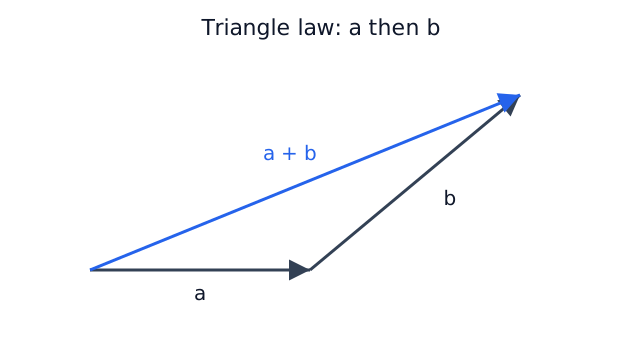
Place b’s tail at a’s head. The directed diagonal a+b joins the initial tail to the final head, matching the page 3 source triangle.
Open original diagram (new tab)

Commutative and associative addition paths

Expand diagram

Use the scrollbars or arrow keys to inspect details.
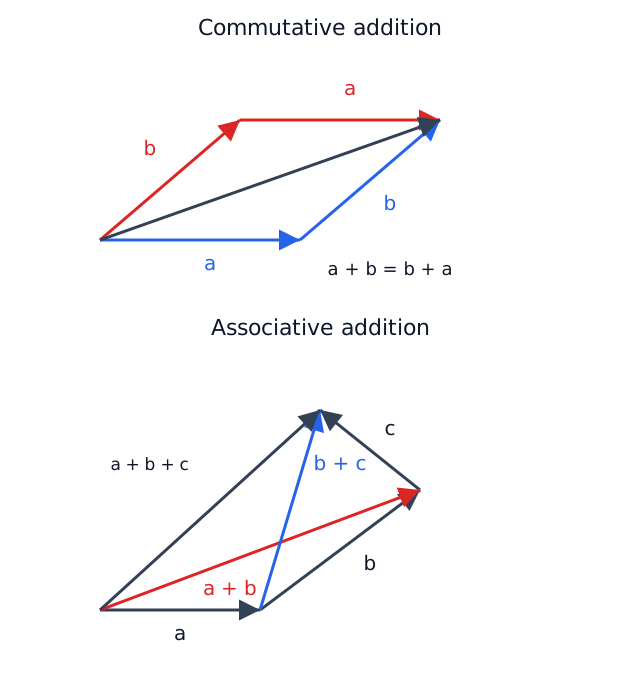
Top: routes a then b and b then a around a parallelogram have the same resultant. Bottom: a then b then c has intermediate diagonals a+b and b+c; both groupings give the same final displacement.
Open original diagram (new tab)

Subtraction and signed scalar multiplication

Expand diagram

Use the scrollbars or arrow keys to inspect details.
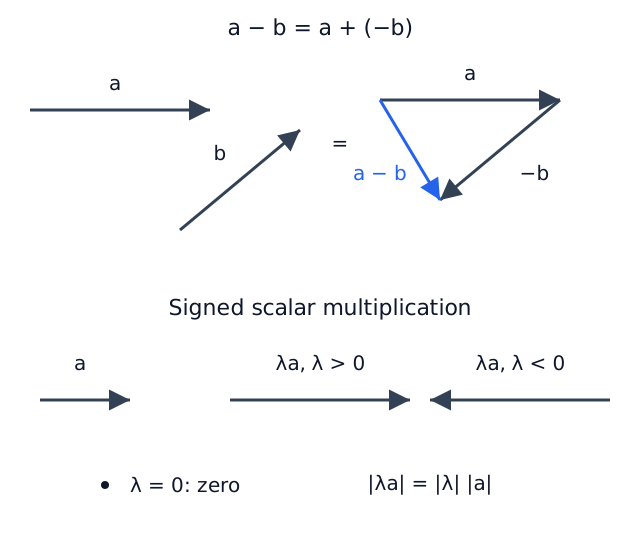
The source subtraction reverses b and adds −b to a, giving a−b. Positive scalar multiplication keeps direction, negative scaling reverses it; zero scaling gives zero. Length illustrations are schematic.
Open original diagram (new tab)
Back to reading