Porisma
Back to reading

Vectors: planes, normals and distances

Meet a line and a plane · Diagrams · Complete reading

Choose another diagram

Method map: Classify a line and a plane in two checks

First test the direction. Only a zero direction test needs a point test. The line direction and plane normal must both be nonzero.

  1. Test the line direction

    Does the line direction have a nonzero dot product with the plane normal?

    r=a+λm\mathbf r=\mathbf a+\lambda\mathbf m

    r⋅n=d\mathbf r\cdot\mathbf n=d

    Yes · nonzeroExactly one intersection

    When m⋅n≠0\mathbf m\cdot\mathbf n\ne0, solve

    λ=d−a⋅nm⋅n.\lambda=\frac{d-\mathbf a\cdot\mathbf n}{\mathbf m\cdot\mathbf n}.

    Substitute this parameter into the line to find the intersection point.

    No · zeroContinue to the point test

    When m⋅n=0\mathbf m\cdot\mathbf n=0, the line direction is parallel to the plane. This alone does not distinguish containment from a disjoint line.

    Never divide by a zero direction test.

  2. Only if zero: test a line point

    Use this check only when the direction test is zero. Does the line point lie in the plane?

    m⋅n=0\mathbf m\cdot\mathbf n=0

    a⋅n=d\mathbf a\cdot\mathbf n=d

    Yes · equalThe whole line lies in the plane

    a⋅n=d\mathbf a\cdot\mathbf n=d: every parameter gives a plane point, so there are infinitely many common points.

    No · unequalParallel and disjoint

    a⋅n≠d\mathbf a\cdot\mathbf n\ne d: substitution is inconsistent, so there are no common points.

    A point on the plane proves containment only after the direction test has returned zero.

Try a worked example

Read a case, make a prediction, then reveal the reasoning. The examples keep their stated values.

Start with this line

Illustration: predict the number of common points.

x+2y−z=3x+2y-z=3 r=λ(2,−1,1)\mathbf r=\lambda(2,-1,1)

If the line crosses, must the intersection parameter be positive?

Show reasoning
  1. 1. Test the direction

    Read a nonzero normal from the plane’s coefficients. The nonzero dot product guarantees exactly one crossing.

    n=(1,2,−1)m⋅n=2−2−1=−1\begin{gathered}\mathbf n=(1,2,-1)\\\mathbf m\cdot\mathbf n=2-2-1\\=-1\end{gathered}
  2. 2. Find the parameter

    Substitute the line into the plane. A line uses every real parameter; a negative value is valid.

    2λ−2λ−λ=3−λ=3λ=−3\begin{gathered}2\lambda-2\lambda-\lambda=3\\-\lambda=3\\\lambda=-3\end{gathered}
  3. 3. Check the intersection

    Use the parameter in the line, then verify the point in the plane.

    P=(−6,3,−3)−6+6+3=3\begin{gathered}P=(-6,3,-3)\\-6+6+3=3\end{gathered}

Change the direction

Keep the plane and origin. Change only the direction.

x+2y−z=3x+2y-z=3 r=λ(2,−1,0)\mathbf r=\lambda(2,-1,0)

Does a zero dot product prove containment?

Show reasoning
  1. 1. The direction is now parallel

    Read the same normal from the plane. The zero dot product requires a point test. Do not divide by it.

    n=(1,2,−1)m⋅n=2−2=0\begin{gathered}\mathbf n=(1,2,-1)\\\mathbf m\cdot\mathbf n=2-2=0\end{gathered}
  2. 2. Test the base point

    The origin is not in this plane. Since the direction is parallel to the plane, no point of the line can enter it.

    a⋅n=0≠3\mathbf a\cdot\mathbf n=0\ne3
  3. 3. Check the whole line

    Substitution gives a contradiction for every parameter: the line and plane are disjoint.

    2λ−2λ=0≠32\lambda-2\lambda=0\ne3

Move the base point

Keep the plane and direction. Change only the base point.

x+2y−z=3x+2y-z=3 r=(3,0,0)+λ(2,−1,0)\begin{aligned}\mathbf r&=(3,0,0)\\&+\lambda(2,-1,0)\end{aligned}

How many common points now?

Show reasoning
  1. 1. Reuse the direction test

    The plane and direction are unchanged, so the dot product is still zero.

    n=(1,2,−1)m⋅n=0\begin{gathered}\mathbf n=(1,2,-1)\\\mathbf m\cdot\mathbf n=0\end{gathered}
  2. 2. Test the new base point

    This point is in the plane. Together with the zero direction test, that proves containment.

    a⋅n=3\mathbf a\cdot\mathbf n=3
  3. 3. Verify every parameter

    The parameters cancel and the plane equation is always satisfied. There are infinitely many common points.

    (3+2λ)−2λ=3\begin{gathered}(3+2\lambda)-2\lambda\\=3\end{gathered}

Compare the three geometric cases

Expand diagram

Use the scrollbars or arrow keys to inspect details.
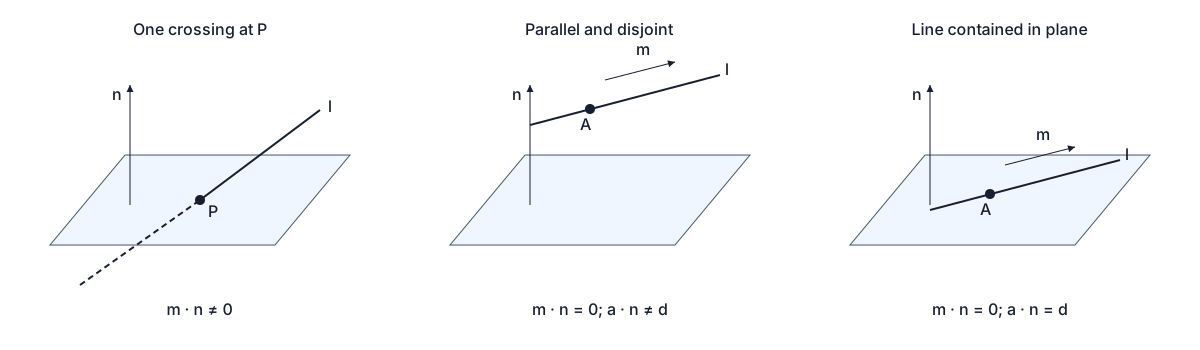
Three source schematic roles, also repeated in the printed summary table: a line crosses the plane at P; a parallel line through A is disjoint from the plane; a line through A lies entirely in the plane. Normal n and direction m are shown. Only the first case has m dot n nonzero.
Open original diagram (new tab)

Acute and obtuse angles to the normal

Expand diagram

Use the scrollbars or arrow keys to inspect details.
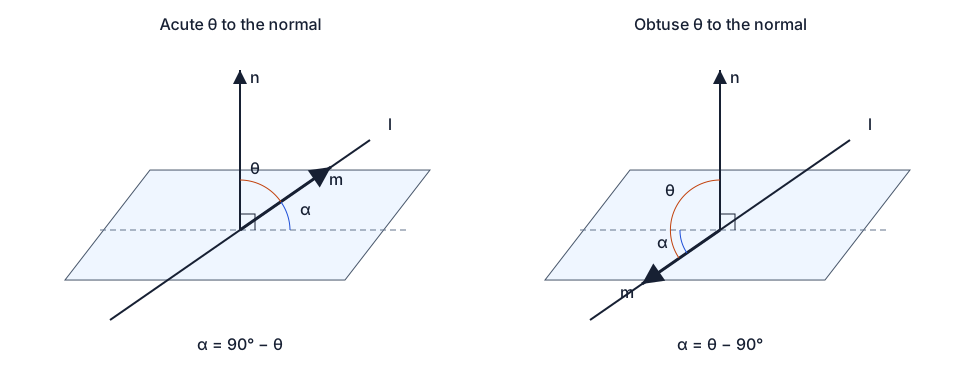
Two schematic source cases share a plane, its normal n, the line and a dashed in-plane projection direction. Left: m points upward along the line, making an acute theta to n; alpha=90 degrees−theta. Right: m is reversed, making theta obtuse; alpha=theta−90 degrees. The line–plane angle stays the same, giving the absolute dot-product sine formula.
Open original diagram (new tab)
Back to reading