Porisma
Back to reading

Vectors: planes, normals and distances

Compare two planes · Diagrams · Complete reading

Choose another diagram

Parallel planes and a common intersection line

Expand diagram

Use the scrollbars or arrow keys to inspect details.
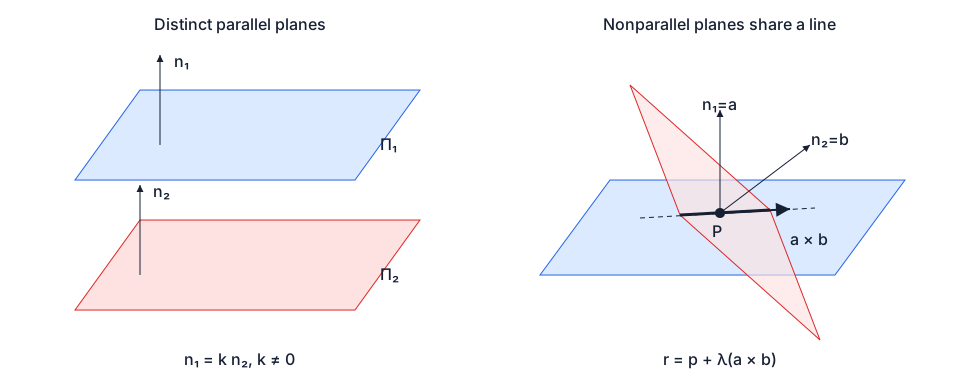
Left: distinct parallel plane patches with parallel normals n1,n2. Right: nonparallel plane patches meet on a straight line through P. Their normals, called a,b in the source intersection method, are n1,n2 here; the common-line direction is their cross product. Screen positions are schematic.
Open original diagram (new tab)

Plane angles from acute or obtuse normal angles

Expand diagram

Use the scrollbars or arrow keys to inspect details.
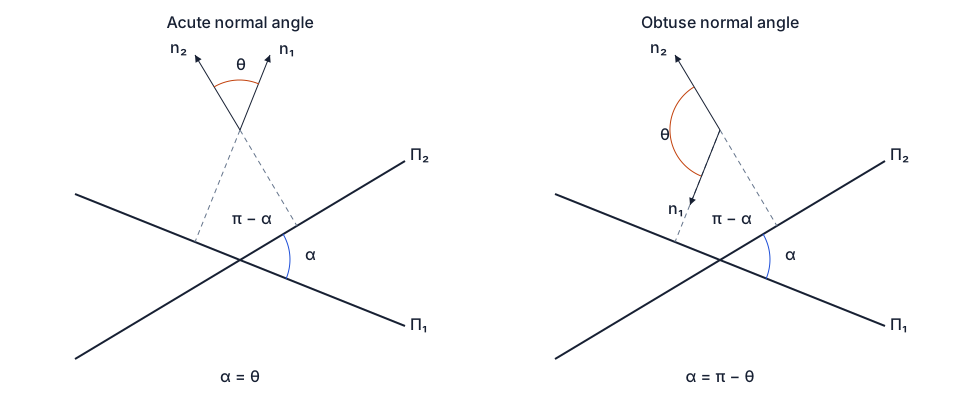
Two cross-sections show the same pair of intersecting planes and their perpendicular normals. With an acute normal angle theta, the plane angle alpha equals theta. Reversing one normal makes theta obtuse and alpha=pi−theta. Supplementary/equal angles give the absolute dot-product cosine formula.
Open original diagram (new tab)
Back to reading