Worked solution
Plot six complex operations and explain their geometry
Given and , mark and label clearly on Argand diagrams the points representing:
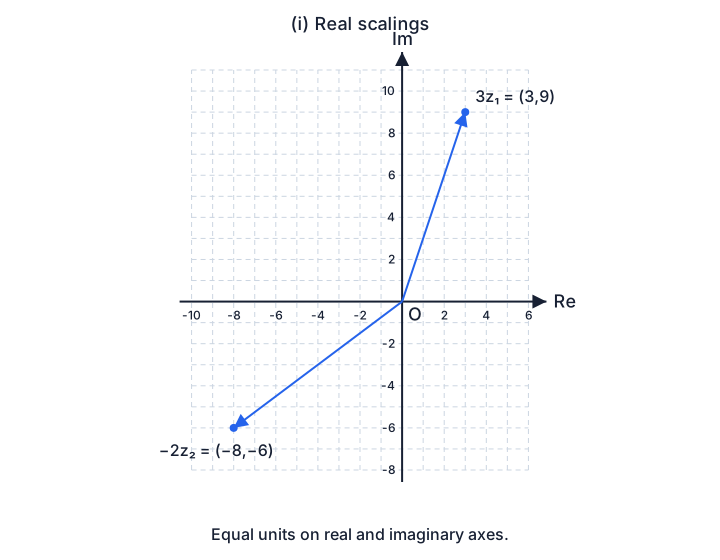
(i) and ;
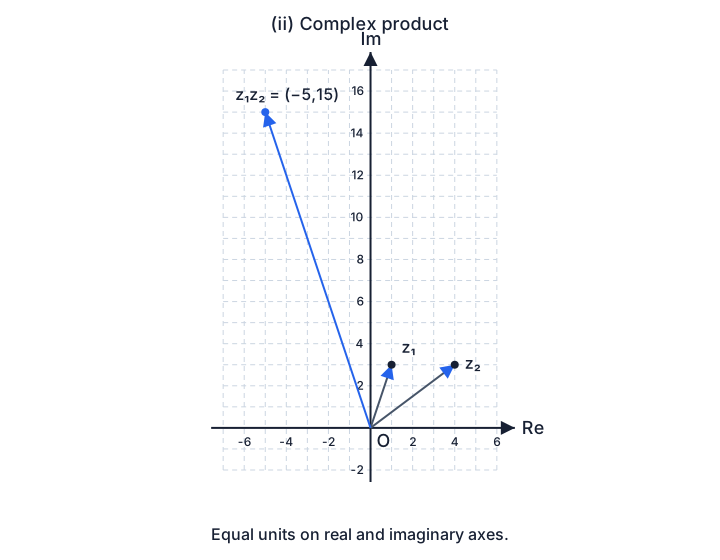
(ii) ;
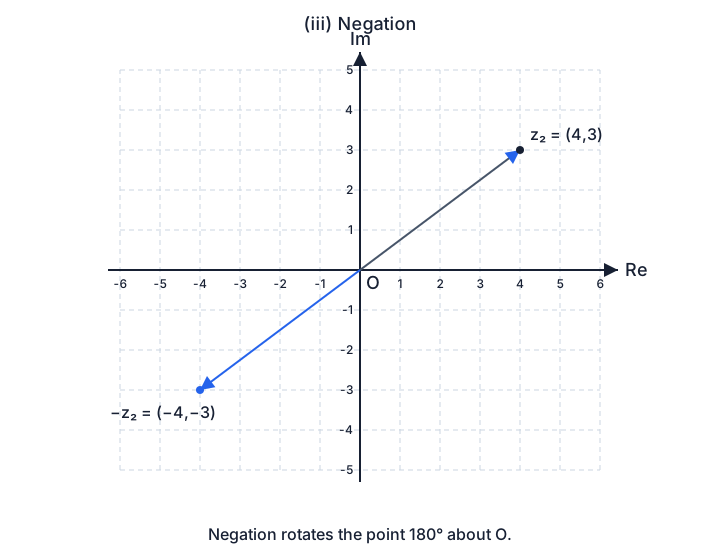
(iii) ;
(iv) ;
(v) ; and
(vi) , and .
Expand diagramFit diagram to page
Use the scrollbars or arrow keys to inspect details.
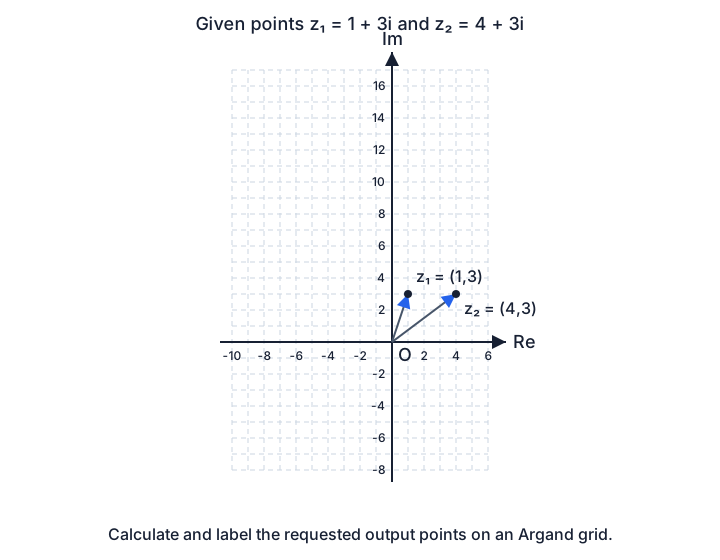
CJC · Lecture · Example 2
(i) Scale and label both points
Answer
at ; at .
The source calculations are and . Plot real parts horizontally and imaginary parts vertically. Positive scaling by 3 keeps the direction; negative scaling by −2 reverses the direction and doubles the distance from O.
Expand diagramFit diagram to page
Use the scrollbars or arrow keys to inspect details.
(ii) Multiply, then plot the product
Answer
at .
Expand every term before using :
The source’s vector remark distinguishes this from the scalar product of the corresponding coordinate vectors: . The complex product is , represented by . These are different operations and different outputs; multiplying complex numbers is not a vector dot product.
Expand diagramFit diagram to page
Use the scrollbars or arrow keys to inspect details.
(iii) Negate and interpret the point
Answer
at .
The source gives . Its coordinates are the negatives of those of , so the point is a 180° rotation of about the origin O. Negation retains the distance from O and reverses the direction.
Expand diagramFit diagram to page
Use the scrollbars or arrow keys to inspect details.
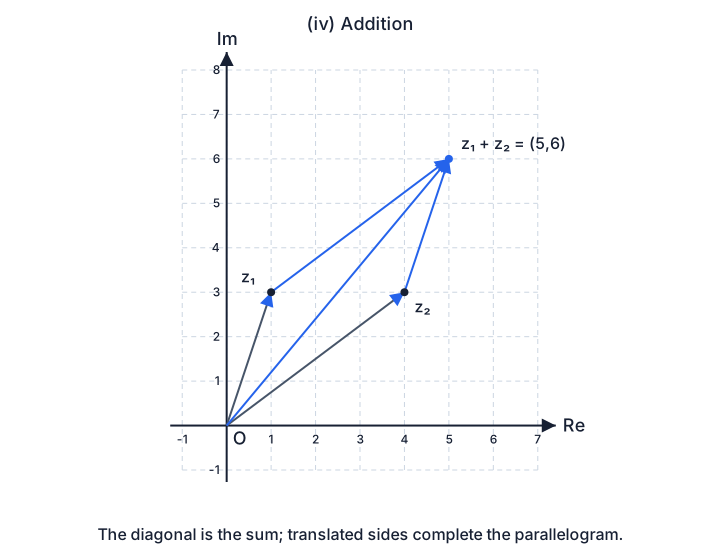
(iv) Add by the parallelogram law
Answer
at .
The source calculation is . The two original vectors form adjacent sides of a parallelogram; the diagonal from O represents their sum. Equivalently, add by translating the point representing by , or add by translating by . The source describes addition as translation from one point to another.
Expand diagramFit diagram to page
Use the scrollbars or arrow keys to inspect details.
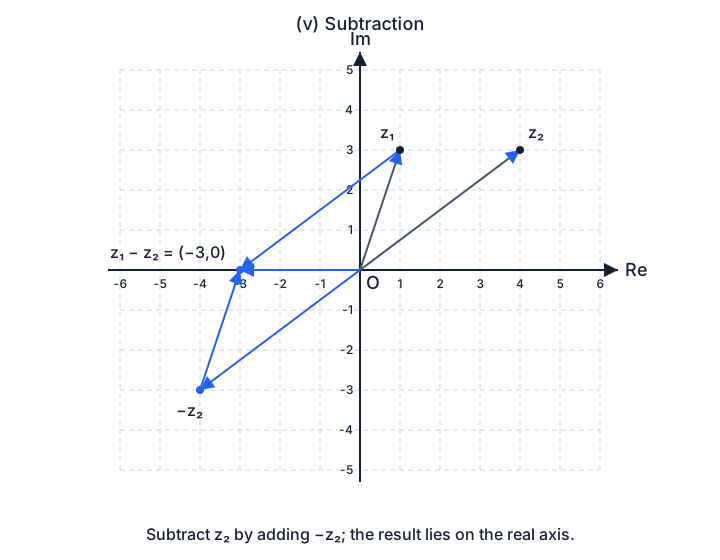
(v) Subtract by adding the negative
Answer
at .
The source gives . Subtraction is addition of : translate the point by to reach . The source also shows the parallelogram with sides and −, giving their sum as the diagonal. The imaginary coefficient is zero, so this result lies on the real axis.
Expand diagramFit diagram to page
Use the scrollbars or arrow keys to inspect details.
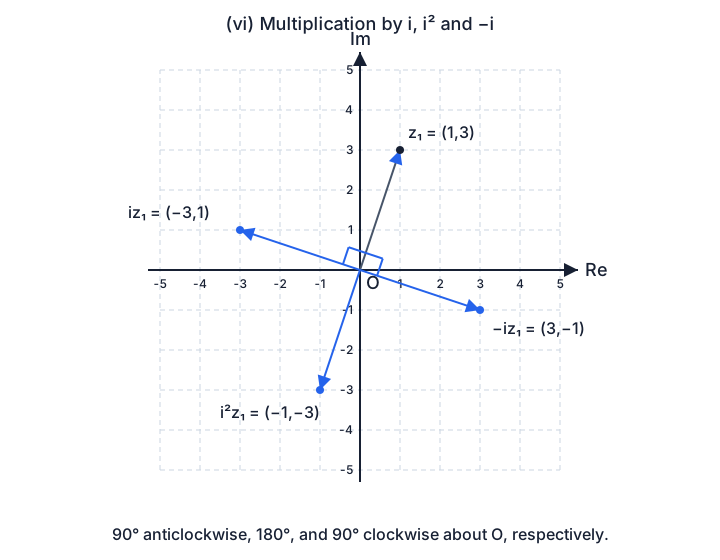
(vi) Label the three rotations
Answer
, , and .
Follow all three printed calculations:
Starting from at , the three points are , and . Multiplication by i rotates 90° anticlockwise, multiplication by rotates 180°, and multiplication by −i rotates 90° clockwise, all about O. Each has the same modulus as . The source recommends drawing every Argand diagram to scale to avoid a distorted view; the plots here use equal x- and y-unit lengths.
Expand diagramFit diagram to page
Use the scrollbars or arrow keys to inspect details.
Solution notes
All six printed asks and every source calculation/geometric interpretation are retained. Equal-unit grids preserve the source recommendation to draw to scale. The source Student copy already prints calculations and several constructions; the Teacher adds the remaining plotted answer points.