Complex numbers and the Argand plane
Practice section 1 of 9
Questions 1–6 in this collection
Practice questions
Worked example · 1 of 6
Explain why the new quadratic roots are not real
In secondary school, and are the roots of . What are the roots of ? Prove that this equation has no real solution, then express its roots using .
CJC · Lecture · Opening activity
Solution
Worked example · 2 of 6
Relate real numbers to complex numbers
What is the relation between the set of real numbers and the set of complex numbers?
CJC · Lecture · Opening activity
Solution
Worked example · 3 of 6
Complete the real and imaginary parts table
Complete the real and imaginary parts for the source examples. The first row is already given.
| z | Re(z) | Im(z) |
|---|---|---|
| ? | ? | |
| ? | ? | |
| ? | ? |
CJC · Lecture · Opening activity
Solution
Worked example · 4 of 6
Compare real and imaginary components to find two real unknowns
Find the values of x and y such that , where .
CJC · Lecture · Example 1
Solution
Worked example · 5 of 6
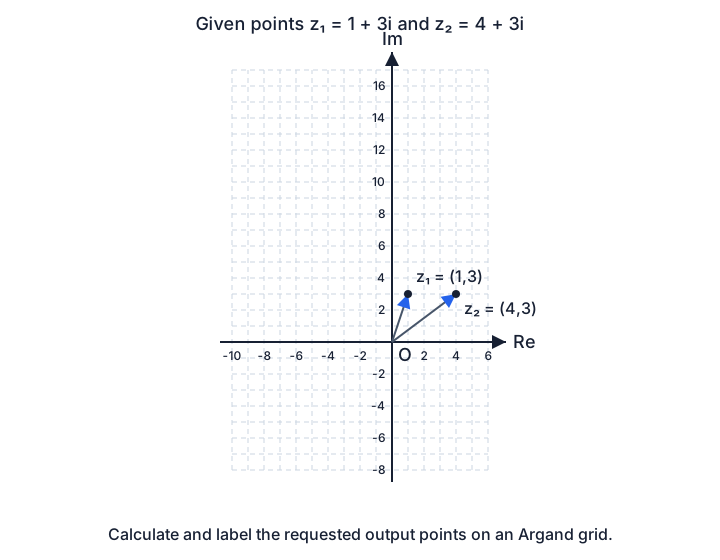
Plot six complex operations and explain their geometry
Given and , mark and label clearly on Argand diagrams the points representing:
(i) and ;
(ii) ;
(iii) ;
(iv) ;
(v) ; and
(vi) , and .
Expand diagramFit diagram to page
Use the scrollbars or arrow keys to inspect details.
CJC · Lecture · Example 2
Solution
Self-practice · 6 of 6
Practise three operations for each of three complex pairs
For each pair of complex numbers and ,
(a) , ;
(b) , ;
(c) , ;
simplify (i) , (ii) and (iii) .
CJC · Self-Practice 1