A hint to get started
From four rectangles to an exact area
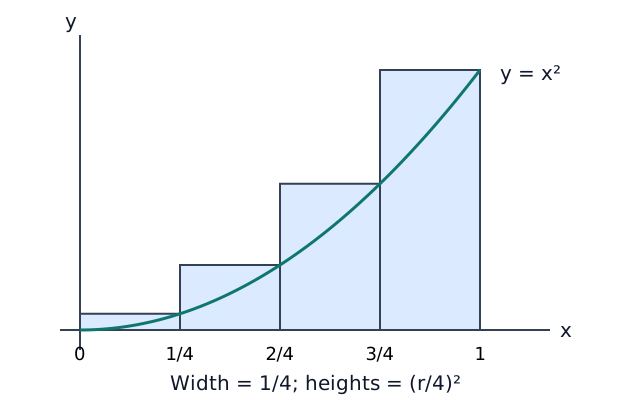
The diagram shows between and , with four rectangles of equal width.
(i) Show that their total area is .
(ii) If rectangles are used instead, deduce an expression for their total area.
(iii) Show that . What does this limit represent?
(iv) Give a reason why . You may use without proof.
Expand diagramFit diagram to page
Use the scrollbars or arrow keys to inspect details.
CJC · Lecture · Example 1
Identify the right endpoints before choosing heights. Factor out the common width and squared denominator to use sigma notation.
For the limit, divide the quadratic numerator and denominator by the highest power, n squared.