Definite integrals, areas and volumes
Practice section 1 of 9
Questions 1–6 in this collection
Practice questions
Worked example · 1 of 6
From four rectangles to an exact area
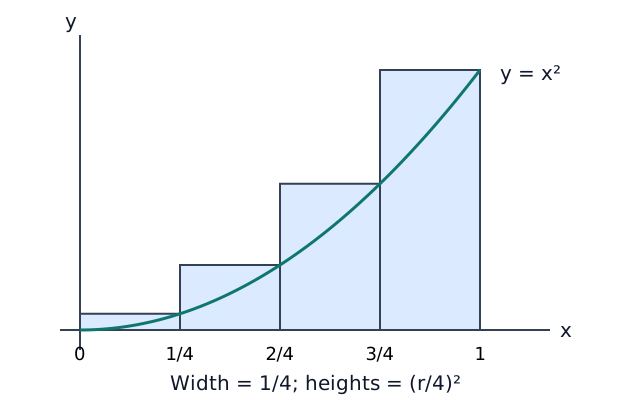
The diagram shows between and , with four rectangles of equal width.
(i) Show that their total area is .
(ii) If rectangles are used instead, deduce an expression for their total area.
(iii) Show that . What does this limit represent?
(iv) Give a reason why . You may use without proof.
Expand diagramFit diagram to page
Use the scrollbars or arrow keys to inspect details.
CJC · Lecture · Example 1
Solution
Worked example · 2 of 6
A reciprocal area and the endpoint choice
Example 2 (Self-Reading). The graph on has rectangles of equal width, using right endpoints. Show that their total area is and find the exact value of . Teacher check: construct a similar diagram using left endpoints.
CJC · Lecture · Example 2
Solution
Worked example · 3 of 6
Evaluate exact definite integrals
Example 3 (Self-Reading). Without the use of a calculator, evaluate (a) , (b) , (c) .
CJC · Lecture · Example 3
Solution
Self-practice · 4 of 6
Practise exact antiderivatives
Without the use of a calculator, evaluate (a) , (b) .
CJC · Lecture · Self-Practice 1
Solution
Worked example · 5 of 6
Change both the variable and the limits
Evaluate exactly, using the substitution .
CJC · Lecture · Example 4
Solution
Worked example · 6 of 6
Use definite integration by parts
Evaluate exactly.
CJC · Lecture · Example 5