Porisma

Worked solution

Sketch three upper solution relations and qualify their endpoints

Show the general solution of y dy/dx=2x−1y\,dy/dx=2x-1, y≥0y\ge0, is y2=2x2−2x+Cy^2=2x^2-2x+C. On one diagram sketch the members with C=−1,0,1C=-1,0,1.

CJC · Lecture · Example 13

Integrate the relation

∫y dy=∫(2x−1) dx\int y\,dy=\int(2x-1)\,dx gives y2/2=x2−x+Ay^2/2=x^2-x+A, hence y2=2x2−2x+Cy^2=2x^2-2x+C with C=2A. Since y is nonnegative, use the upper square root where real.

How did this part go?

Retain all three source members and calculator entries

The source enters Y1=2x2−2xY_1=\sqrt{2x^2-2x} (C=0), Y2=2x2−2x−1Y_2=\sqrt{2x^2-2x-1} (C=−1), Y3=2x2−2x+1Y_3=\sqrt{2x^2-2x+1} (C=1). For C=−1 the geometric x-intercepts are (1±3)/2≈−0.366,1.37(1\pm\sqrt3)/2\approx-0.366,1.37. For C=0 they are 0 and 1. The C=1 curve is smooth for all real x, with minimum (1/2,1/2)≈(0.5,0.707)(1/2,1/\sqrt2)\approx(0.5,0.707) and y-intercept 1.

How did this part go?

Distinguish the plotted closure from a differentiable solution

For C=−1 and C=0, the zero-height endpoints are valid points of the implicit squared relation, but not classical differentiable solutions of the original equation there: at y=0, the left side would be 0 while 2x−1 is nonzero. The classical solution branches therefore use the open intervals beyond those endpoints; the displayed figure marks them open while retaining their limiting coordinates. The Teacher note labels family sketches as outside the stated examination syllabus; this exercise is retained as source enrichment rather than removed.

How did this part go?

Compare your sketch

Expand diagram

Use the scrollbars or arrow keys to inspect details.
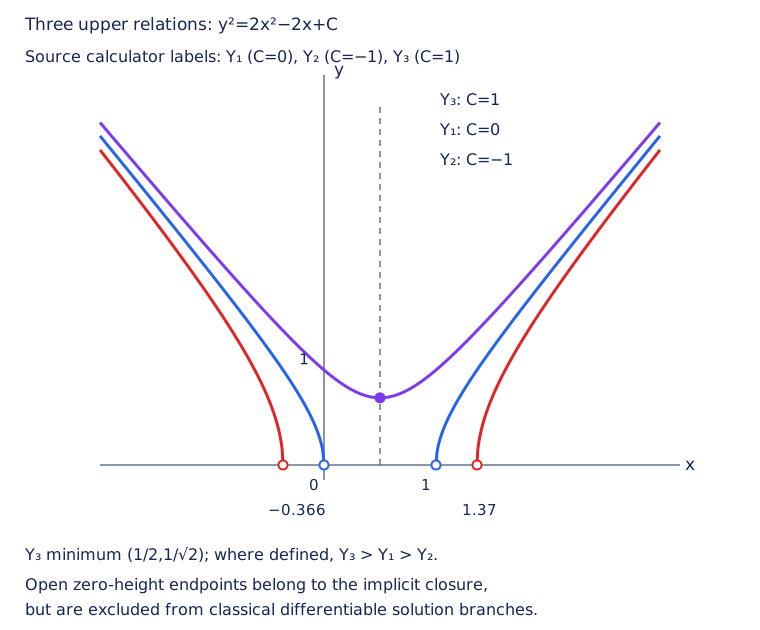
Three upper curves on common axes: C=1 has minimum (1/2,1/sqrt2) and y-intercept 1; C=0 has open limiting endpoints x=0,1; C=−1 has open limiting endpoints (1−sqrt3)/2 and (1+sqrt3)/2, labelled approximately −0.366 and 1.37. All are symmetric about x=1/2; colors are supplemented by C and source Y labels. Open endpoints are excluded from classical differentiable solutions.

Common mistakes

A plotted endpoint of an implicit relation need not admit a finite derivative satisfying the original equation.

Read the hint