Worked solution
Classify the turning points of a rational curve
Determine the coordinates and nature of the turning points of the graph .
CJC · Lecture · Example 1
Differentiate and find every stationary point
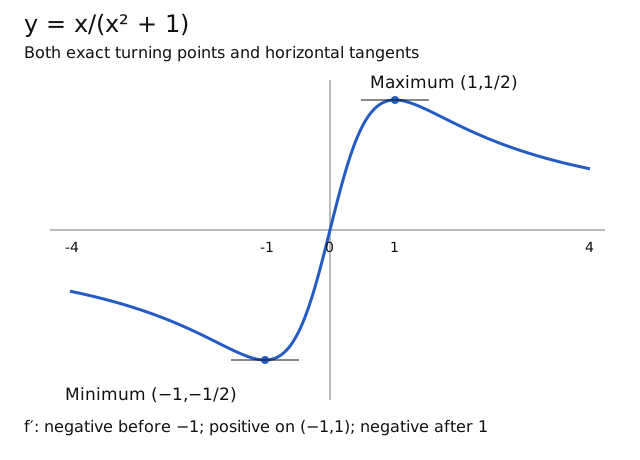
For , the quotient rule gives . The denominator is positive for every real . Thus exactly at , giving and . The Teacher supplies the blue quotient-rule and coordinate working missing from the Student space.
Classify with the first derivative test
At , the derivative signs immediately left, at, and right are : the tangent rises, is horizontal, then falls. Hence is a local maximum. At , the signs are : falling, horizontal, rising, so is a local minimum. These retain both printed sign/tangent tables. The Teacher advises an analytical method when the question says “exact”, “by using differentiation” or “without the use of a G.C.”.
Check the alternative second derivative method
The printed quotient-rule second derivative is . It simplifies to . At , , confirming the maximum; at , , confirming the minimum. The distinct Teacher note recommends the first derivative test when obtaining the second derivative is not easy.
Set up the source calculator graph
The self-reading alternative begins Y=, enter , then GRAPH. Use WINDOW to magnify the region if needed. The source screen shows the curve crossing the origin, with a trough near and a peak near . This is numerical exploration; the analytical result above supplies the exact coordinates.
Bracket and estimate the minimum
Press 2nd → TRACE, select 3:minimum, place the cursor slightly left of the minimum and press ENTER, then slightly right and ENTER, then ENTER again for the guess. The printed result is ; the calculator screen’s x-value is approximate, rather than exactly .
Bracket and estimate the maximum
Press 2nd → TRACE, select 4:maximum and similarly supply left bound, right bound and guess around the maximum, pressing ENTER at each stage. The printed result is . Both originals’ step 6 instructions accidentally repeat “minimum point”; the selected menu and result show that the intended target here is the maximum. That correction is stated separately from the unchanged native transcription. No operation of a physical calculator is claimed.
Compare your sketch
Expand diagramFit diagram to page
Use the scrollbars or arrow keys to inspect details.
Common mistakes
A zero derivative gives a candidate. Classify it and state its y-coordinate; follow analytical-method restrictions in the question.
Solution notes
Both Student/Teacher PDFs 1–6 (printed 27–32) directly viewed. Teacher working and two method-selection notes integrated into their relevant steps. No printed marks or past-paper attribution. Simplified second derivative and real-domain explanations independently checked.