Applications of differentiation
Practice section 1 of 8
Questions 1–6 in this collection
Practice questions
Worked example · 1 of 6
Classify the turning points of a rational curve
Determine the coordinates and nature of the turning points of the graph .
CJC · Lecture · Example 1
Solution
Worked example · 2 of 6
Classify stationary points on two implicit branches
Given the curve , determine the coordinates and nature of the stationary points.
CJC · Lecture · Example 2
Solution
Self-practice · 3 of 6
Find both turning points of a cubic
The curve has equation . Determine the coordinates and nature of its turning points.
CJC · Lecture · Self-Practice 1
Solution
Worked example · 4 of 6
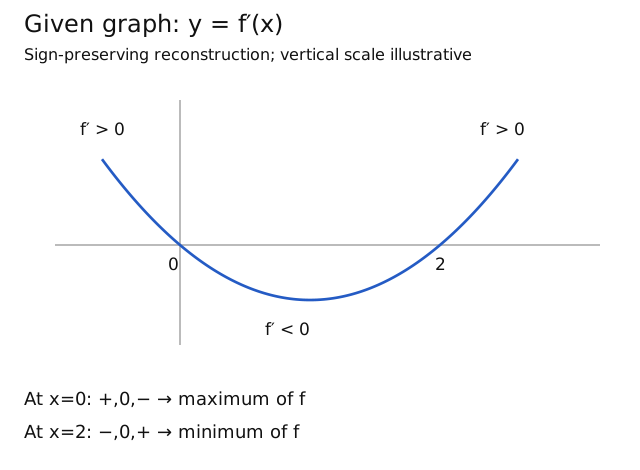
Read stationary points from a derivative graph
The derivative graph is shown. Find the x-coordinates of the stationary points of and determine their nature.
Expand diagramFit diagram to page
Use the scrollbars or arrow keys to inspect details.
CJC · Lecture · Example 3
Solution
Worked example · 5 of 6
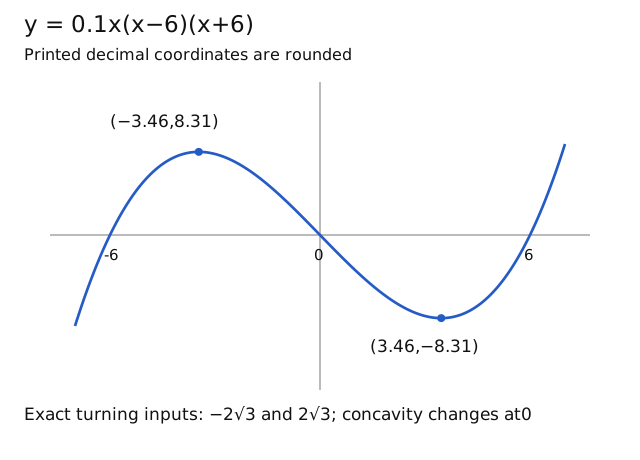
Match slope and concavity intervals on a cubic graph
Using the given graph of , match (a) strictly increasing, (b) strictly decreasing, (c) concave upwards and (d) concave downwards to the printed sets: ; ; ; .
Expand diagramFit diagram to page
Use the scrollbars or arrow keys to inspect details.
CJC · Lecture · Example 4
Solution
Worked example · 6 of 6
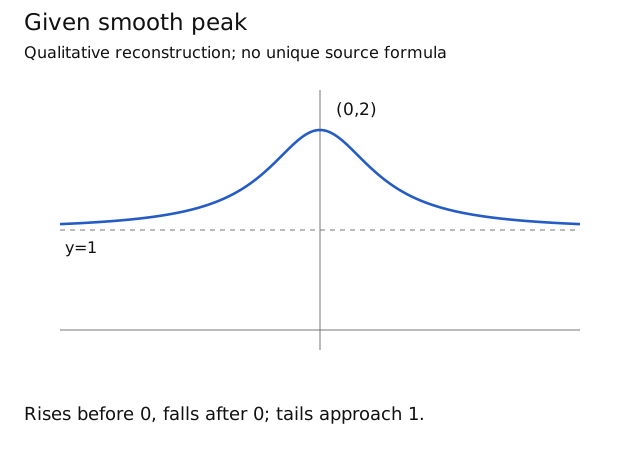
Sketch a derivative from a smooth peak and horizontal tails
Sketch the graph of the derivative function for the given graph.
Expand diagramFit diagram to page
Use the scrollbars or arrow keys to inspect details.
[2006/HCI/Promo/1]
CJC · Lecture · Example 5