Worked solution
Classify stationary points on two implicit branches
Given the curve , determine the coordinates and nature of the stationary points.
CJC · Lecture · Example 2
Differentiate the original relation implicitly
, so . Both originals note that there is no need to make the subject before differentiating. On this real curve , so ; no real curve point is lost by this division.
Find both stationary coordinates
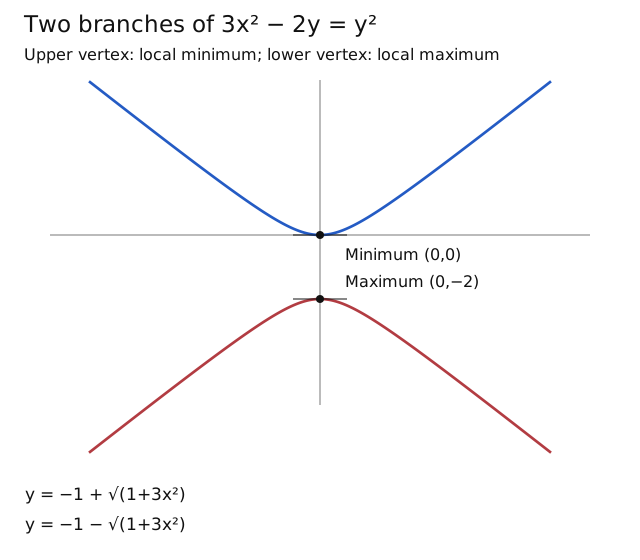
gives . Substitute into the original relation: , hence and or . The candidates are and , on two different branches.
Differentiate the undivided equation again
From obtain . Thus . The Teacher note explains why this second derivative test is convenient here, unlike Example 1: the implicit first-derivative equation makes the second derivative relatively easy to obtain.
Classify each branch locally
At both stationary points . At , , so it is a local minimum. At , , so it is a local maximum. The source prints the signs and conclusions; these numerical second-derivative values are independently evaluated.
Retain the Teacher graphing alternative
Complete the square: , , , and . The Teacher blue completion and labelled sketch plot both branches and confirm minimum on the upper branch and maximum on the lower. The Student graphing space is blank. Plotting both branches does not turn the whole relation into one single-valued function.
Compare your sketch
Expand diagramFit diagram to page
Use the scrollbars or arrow keys to inspect details.
Common mistakes
Keep both branches and both y-coordinates; a second derivative test is applied to a local branch.
Solution notes
Both originals visually compared. Complete source working and distinct Teacher guidance integrated; independently authored domain/precision qualifications are identified. No printed marks or past-paper attribution.