Worked solution
Read stationary points from a derivative graph
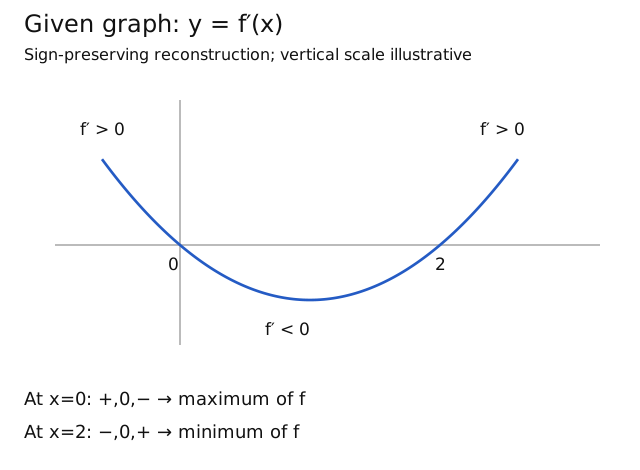
The derivative graph is shown. Find the x-coordinates of the stationary points of and determine their nature.
Expand diagramFit diagram to page
Use the scrollbars or arrow keys to inspect details.
CJC · Lecture · Example 3
Locate the zeros of the derivative
The graph crosses the x-axis at and . Thus at these two inputs. The graph is above the axis before 0, below it between 0 and 2, and above it after 2. No formula or vertical scale for the derivative is supplied.
Use the signs around zero
Immediately left of 0, at 0 and right of 0, the derivative signs are . The original function’s tangent rises, is horizontal, then falls. Therefore is a local maximum of , as in the Teacher-filled sign/slope table.
Use the signs around two
The signs around 2 are . The original function falls, has a horizontal tangent, then rises, so is a local minimum. The requested outputs are x-coordinates and natures; y-coordinates of cannot be recovered from the given derivative graph alone. Both source tables and the Teacher conclusions are retained.
Common mistakes
A minimum of the derivative graph is not automatically a minimum of the original function.
Solution notes
Both originals visually compared. Complete source working and distinct Teacher guidance integrated; independently authored domain/precision qualifications are identified. No printed marks or past-paper attribution.