Worked solution
Sketch a derivative from a smooth peak and horizontal tails
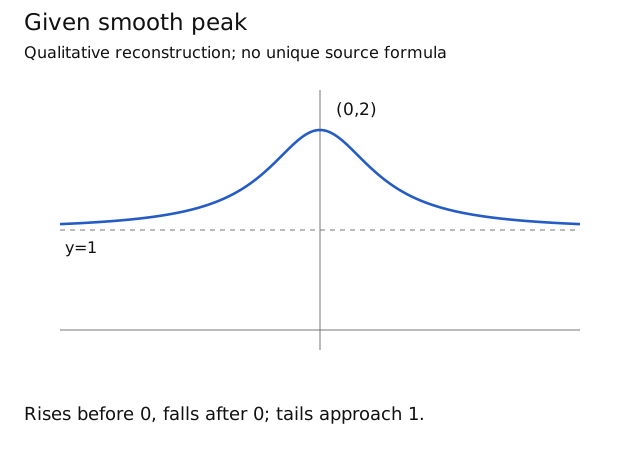
Sketch the graph of the derivative function for the given graph.
Expand diagramFit diagram to page
Use the scrollbars or arrow keys to inspect details.
[2006/HCI/Promo/1]
CJC · Lecture · Example 5
Use the peak and the slope signs
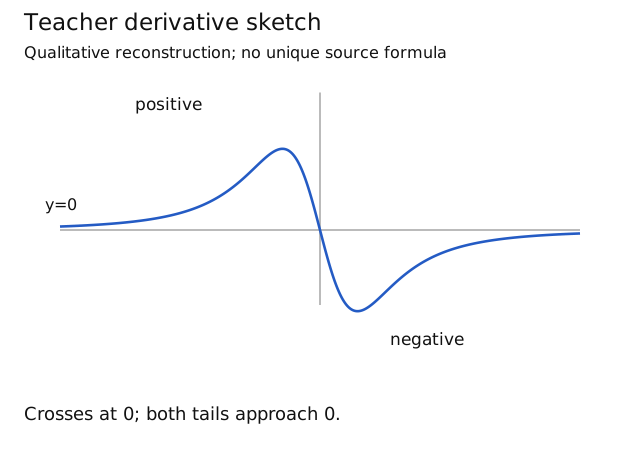
The source graph has a maximum at and rises on then falls on . Therefore the derivative is positive left of 0, zero at 0 and negative right of 0. The original height 2 does not become a derivative height 2.
Retain the Teacher derivative shape
The blue Teacher sketch has a positive lobe to the left, a negative lobe to the right, crosses at the origin and approaches the horizontal line in both tails. The original curve approaches and its drawn slopes flatten. This flattening supports the derivative tail behaviour for this sketch; a horizontal function asymptote alone is not a universal guarantee about derivative limits.
Avoid assigning unsupported numerical details
No formula, scale for the derivative’s lobe heights or exact inputs for its extrema are supplied. The reconstruction preserves the source signs, origin crossing and tail relationships, without inventing numerical labels for the derivative extrema.
Compare your sketch
Expand diagramFit diagram to page
Use the scrollbars or arrow keys to inspect details.
Common mistakes
The derivative records slope, not the height of the original graph. Do not join across excluded asymptote inputs.
Solution notes
Both source copies visually compared. Student solution axes/space are blank; complete blue Teacher sketches and labels retained through qualitative mathematical reconstructions with text alternatives. No printed marks. An illustrative drawing model is not asserted as the uniquely determined original function.