Worked solution
Sketch derivative branches around two vertical asymptotes
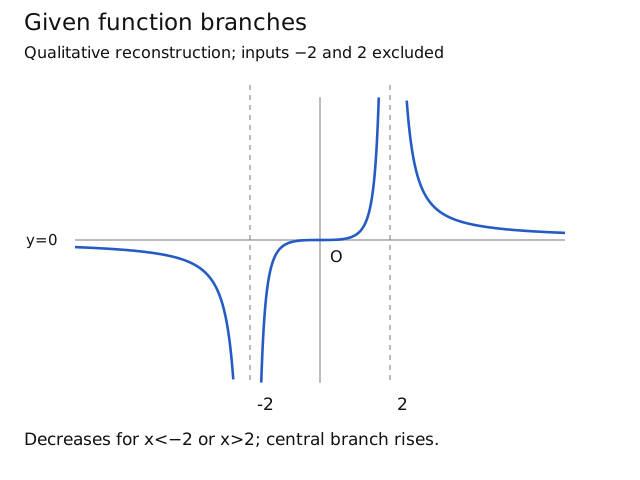
The diagram shows a sketch of . (a) State the range of x for which f is strictly decreasing. (b) Sketch on a separate diagram for all x.
Expand diagramFit diagram to page
Use the scrollbars or arrow keys to inspect details.
[2006/IJC/Promo/7]
CJC · Lecture · Example 6
(a) Read where the original graph falls
The printed Teacher answer is or . The inputs are vertical asymptotes, not points of the curve; they are excluded. Between them the given curve rises, passing through the origin with a horizontal stationary inflection.
(b) Mark the domain and derivative signs
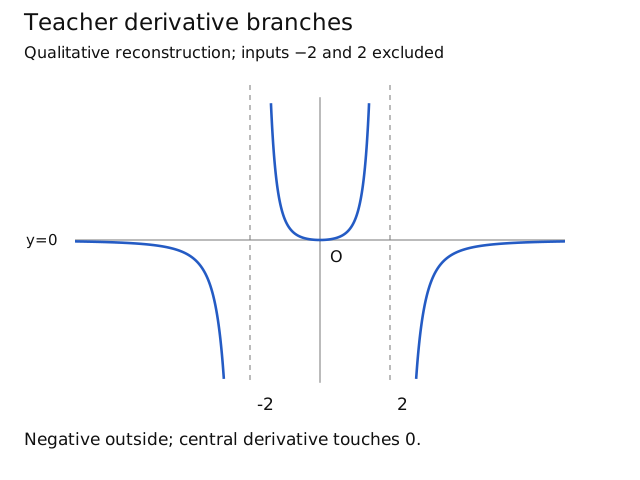
The source Teacher derivative sketch retains vertical asymptotes and . It is negative outside these inputs, positive on and , and zero at 0. The central branch touches the x-axis at the origin as a local minimum of the derivative, rather than crossing it.
(b) Preserve all branch-end directions
For the drawn derivative, approach from the left gives and from the right ; approach 2 from the left gives and from the right . The outer derivative branches approach from below in both distant tails. These are features of the Teacher sketch, justified by the source curve’s slopes, not by applying an asymptote rule without looking at the graph.
(b) Interpret “for all x” on the original domain
Include every branch on the domain , with the two asymptote inputs excluded. The whole relation is not continued through an asymptote. No exact function formula, derivative branch height or additional intercept is supplied.
Compare your sketch
Expand diagramFit diagram to page
Use the scrollbars or arrow keys to inspect details.
Common mistakes
The derivative records slope, not the height of the original graph. Do not join across excluded asymptote inputs.
Solution notes
Both source copies visually compared. Student solution axes/space are blank; complete blue Teacher sketches and labels retained through qualitative mathematical reconstructions with text alternatives. No printed marks. An illustrative drawing model is not asserted as the uniquely determined original function.