Applications of differentiation
Practice section 2 of 8
Questions 7–12 in this collection
Practice questions
Worked example · 1 of 6
Sketch derivative branches around two vertical asymptotes
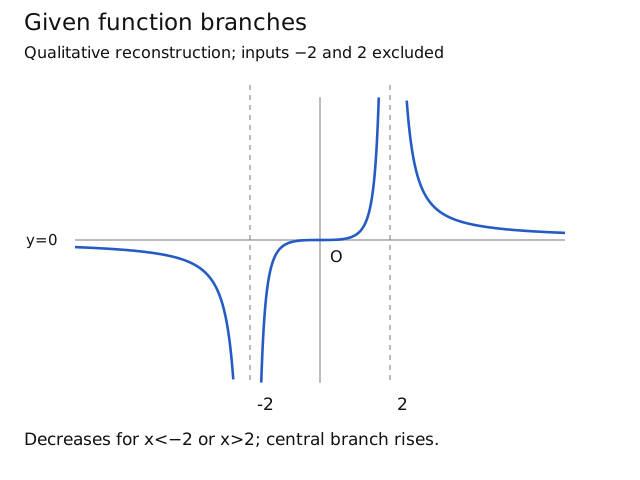
The diagram shows a sketch of . (a) State the range of x for which f is strictly decreasing. (b) Sketch on a separate diagram for all x.
Expand diagramFit diagram to page
Use the scrollbars or arrow keys to inspect details.
[2006/IJC/Promo/7]
CJC · Lecture · Example 6
Solution
Worked example · 2 of 6
Transfer an oblique asymptote to the derivative sketch
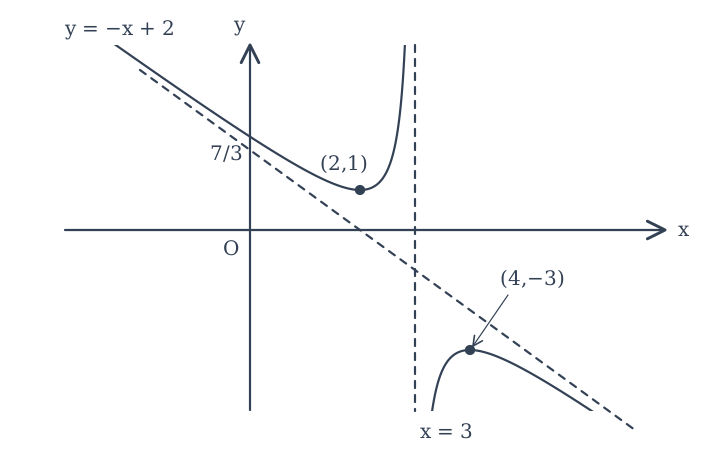
The diagram shows the graph of . Sketch the curve of .
Expand diagramFit diagram to page
Use the scrollbars or arrow keys to inspect details.
[2010/VJC/Promo/6(ii)]
CJC · Lecture · Example 7
Solution
Worked example · 3 of 6
Find a tangent analytically and read the calculator workflow
Example 8 (Self-Reading): is the point on the curve . Find the gradient of the curve at and the equation of the tangent at this point.
CJC · Lecture · Example 8
Solution
Self-practice · 4 of 6
Practise the point-slope tangent equation
Find the equation of the tangent to the curve at the point .
CJC · Lecture · Self-Practice 2
Solution
Worked example · 5 of 6
Find a normal from an implicit derivative
A curve is defined by the equation . Find the equation of the normal to the curve at the point .
[2008/MI/Promo/PU2/II/5]
CJC · Lecture · Example 9
Solution
Self-practice · 6 of 6
Find an exact normal on a trigonometric curve
A curve is defined by , . Find the exact equation of the normal at .
CJC · Lecture · Self-Practice 3