Worked solution
Transfer an oblique asymptote to the derivative sketch
The diagram shows the graph of . Sketch the curve of .
Expand diagramFit diagram to page
Use the scrollbars or arrow keys to inspect details.
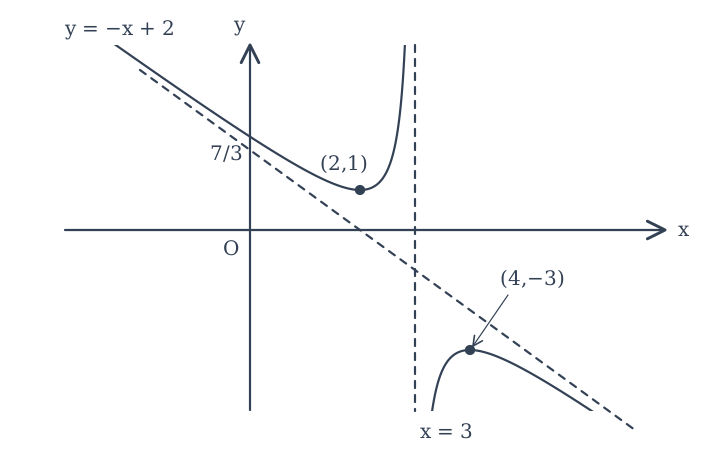
[2010/VJC/Promo/6(ii)]
CJC · Lecture · Example 7
Read both stationary points
The given minimum gives derivative zero and a negative-to-positive crossing. The maximum gives and a positive-to-negative crossing. Thus the derivative is negative for and , positive for and , and undefined at 3.
Retain all asymptotes and branch directions
The Teacher sketch has vertical asymptote , with derivative tending to from both sides. Both outer tails approach from above, corresponding to the original graph’s limiting slope near . The left derivative branch increases and the right decreases. This uses the slopes of the source sketch; an oblique asymptote alone does not force a derivative limit.
Keep function heights separate from slopes
The source function has y-intercept , minimum and maximum . These heights do not become derivative heights. No exact formula is supplied. The same attributed question occurs as Review 4, where the source additionally prints 3 marks; no marks are printed in this lecture occurrence.
Compare your sketch
Expand diagramFit diagram to page
Use the scrollbars or arrow keys to inspect details.
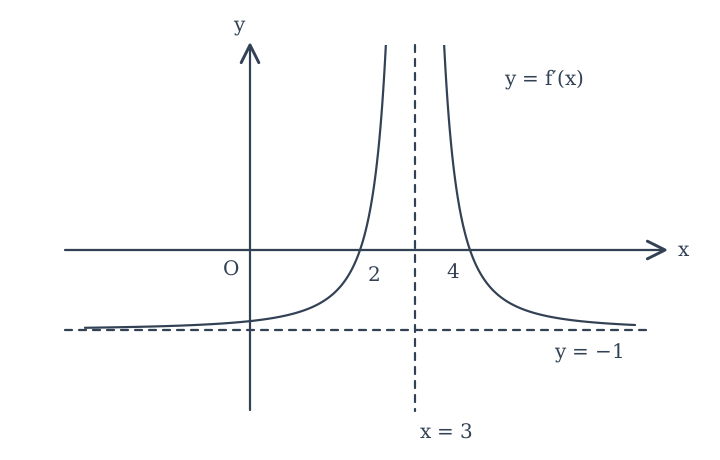
Common mistakes
The original y-intercept 7/3 is a height, not a derivative value.
Solution notes
Both source copies visually compared; source wording, displayed results and pagination retained. Independently authored analytical explanations are distinguished from printed working.
Repeated identity compared with cjc-review-differentiation-applications-04: same attribution, labelled graph, ask and answer; lecture number 7 differs from review number 4. Existing canonical review wording and 3 marks preserved. Lecture occurrence retained with its own source pagination, without adding an original-bank identity.