Worked solution
Maximise an isosceles triangle inscribed in a circle
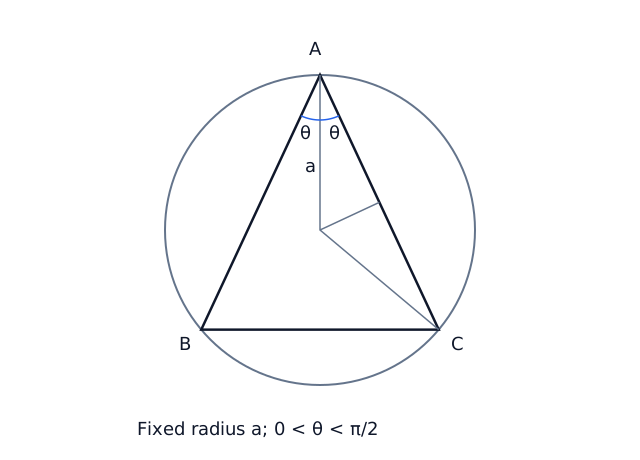
Example 15 (Self-Reading): An isosceles triangle , with , is inscribed in a fixed circle of radius , with . Express its area in terms of , and hence show that the area is maximum when the triangle is equilateral.
CJC · Lecture · Example 15
Form the area using the double-angle identity
Both copies print the complete solution and diagram. For and , . Thus . The source callout identifies .
Differentiate using the product rule
The source labels the product-rule step: .
Reject the excluded endpoint and test the remaining root
Setting the derivative to zero gives or . The first gives , excluded by . The second gives and . The complete source sign table has derivative positive to the left, zero at , negative to the right, with rising, horizontal and falling tangent directions. Thus the area is maximised at .
Finish the requested equilateral conclusion
At , the apex angle is . Because , each base angle is . All three angles are 60°, so the triangle is equilateral. This explicit angle argument completes the requested conclusion after the source’s maximum test; it is independently authored.
Compare your sketch
Expand diagramFit diagram to page
Use the scrollbars or arrow keys to inspect details.
Common mistakes
Do not accept θ=π/2: it is outside the nondegenerate triangle domain. The apex angle is 2θ, not θ.
Solution notes
Both original copies visually compared. Printed working and shared guidance retained; additional domain and verification explanations are independently authored. No marks or past-paper attribution printed.