Worked solution
Apply the vertical-line test
State and justify which of the following is a function. (a) , . (b) , , .
CJC · Functions · Example 2
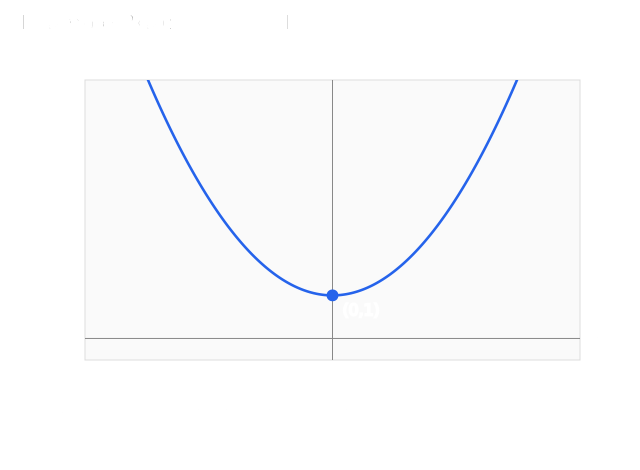
(a) One ordinate for every input
Answer
f is a function.
The source parabola has vertex . Every vertical line meets its graph at most once, so each input has exactly one output.
Expand diagramFit diagram to page
Use the scrollbars or arrow keys to inspect details.
(b) A single counterexample is enough
Answer
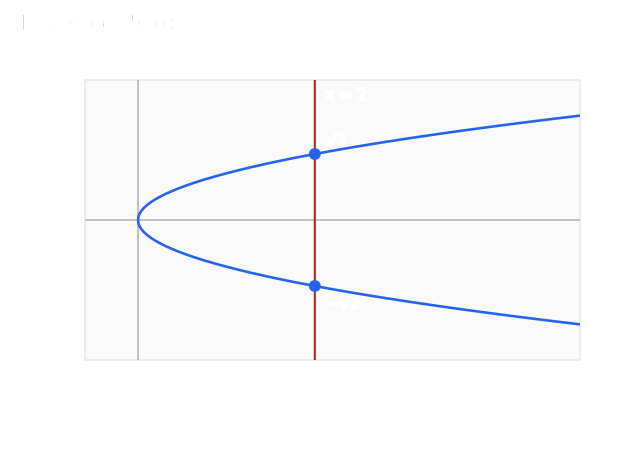
g is not a function.
The relation has both branches and . The Teacher adds the vertical line , which meets both branches. Independently those outputs are and , two distinct values for one allowed input. At zero the branches meet; that does not repair the failure elsewhere.
Expand diagramFit diagram to page
Use the scrollbars or arrow keys to inspect details.
Solution notes
The radical is present in both original page images but lost in the native text extraction. The original source uses g as a candidate relation to be tested, not as an assertion that it is already a function.