Worked solution
Identity rules can have different domains
Let be a one-to-one function defined by , , . Define (a) the inverse function , (b) the function , and (c) the function . Is ?
CJC · Functions · Example 10
(a) Define the inverse
Answer
, .
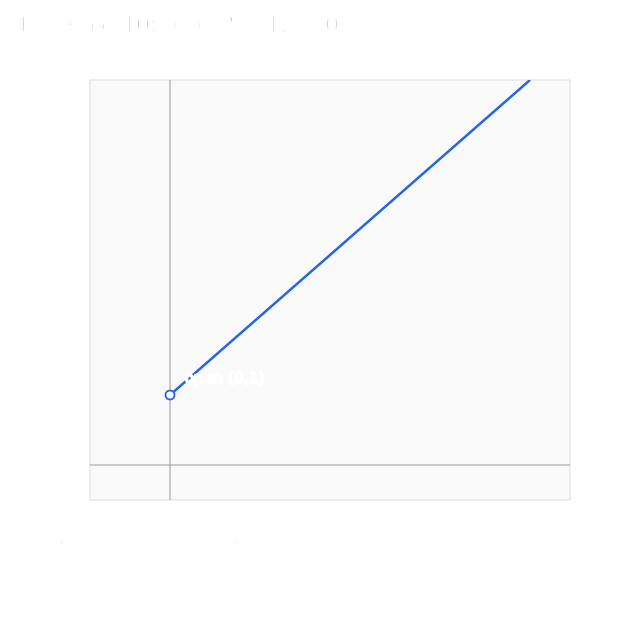
Let , so . From , rearrange to , hence . Rename the input to . The original graph is an increasing line on with excluded endpoint ; therefore . The inverse definition includes this domain.
Expand diagramFit diagram to page
Use the scrollbars or arrow keys to inspect details.
(b) Define inverse after f
Answer
, .
. Its domain is the original . Every intermediate output is in , so the composite exists on that entire domain.
(c) Define f after inverse
Answer
, .
. Its domain is the original inverse domain . The inverse outputs lie in , so the composite exists on that entire domain.
Compare the two identity functions
Answer
because their domains differ.
The source comparison bubble answers the additional question explicitly: . Both rules return their input, but one accepts every positive number while the other accepts only numbers greater than 1. For example, belongs only to the first domain. A rule alone does not define a function.