Worked solution
A self-inverse map and a restricted modulus inverse
A function is said to be self-inverse if for all in its domain. The functions are defined by , , , and , , . (i) Explain why exists and show that is self-inverse. Hence, or otherwise, evaluate . (ii) Find an expression for . (iii) Sketch and on the same diagram, illustrating their relationship and labelling axial intercepts, if any. Write down the set of values of satisfying . (iv) Show that exists and find its exact range.
2017/NJC/II/2
CJC · Functions · Example 13
(i) Establish the inverse and self-inverse property
Answer
on , so .
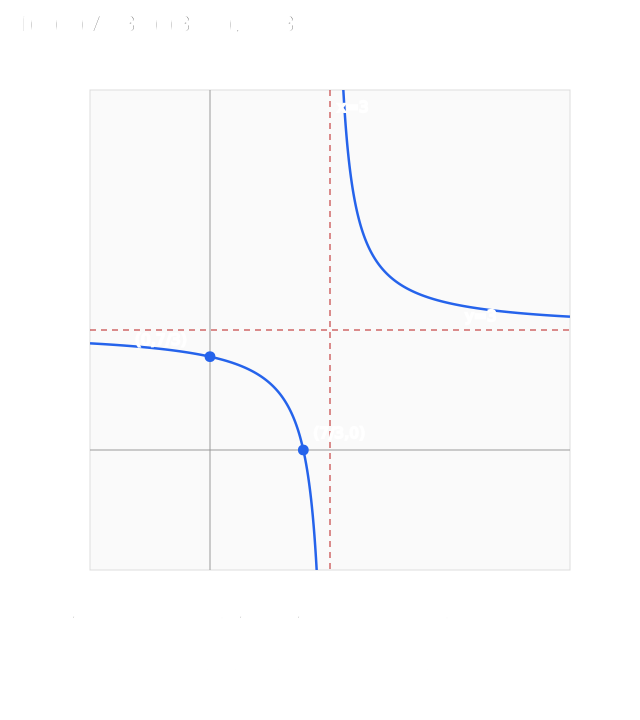
The source graph has asymptotes , , and axial intercepts and . Each horizontal line meets it at most once: rewriting shows that the left branch has outputs below 3, the right branch outputs above 3, and each branch decreases strictly. Thus is one-to-one. Let , so . Then , , , and . Rename the inverse input to obtain the stated rule. Its domain is . Rule and domain agree, proving self-inverse behaviour.
Expand diagramFit diagram to page
Use the scrollbars or arrow keys to inspect details.
(i) Evaluate the 2003rd iterate
Answer
.
Since , gives . Then gives , and gives . Continuing, , so . Hence . The superscript counts compositions; it is not a pointwise power. Independently 5 and 4 form a two-cycle and neither hits the excluded input 3.
(ii) Select and invert the permitted branch
Answer
, .
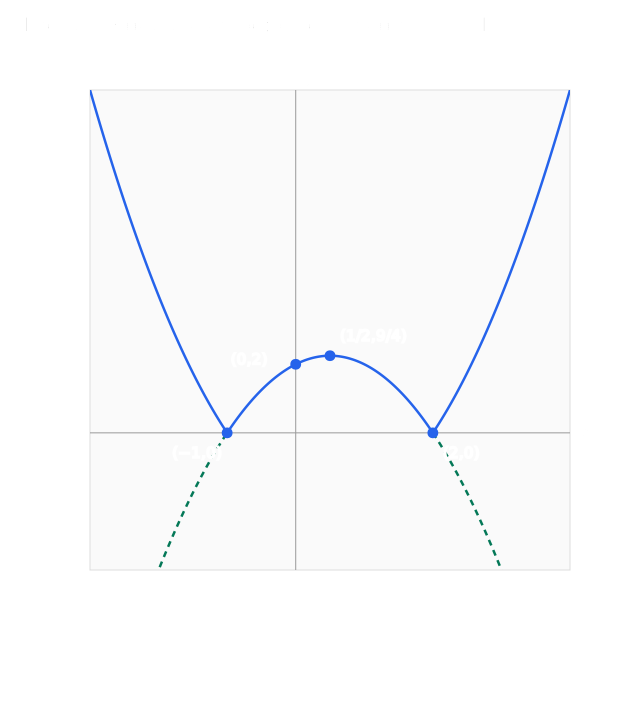
Choose the equation before rearranging, as the Teacher note stresses. On , , so . The unrestricted modulus illustration has roots −1,2 and central maximum ; only its left branch belongs to . Set , so . Complete the square: , hence , , and . Reject the positive branch because the original inputs satisfy . Thus ; rename its input to . The original left branch has range , so that is the inverse domain, not merely the larger algebraic radical domain .
Expand diagramFit diagram to page
Use the scrollbars or arrow keys to inspect details.
(iii) Sketch the inverse relationship
Answer
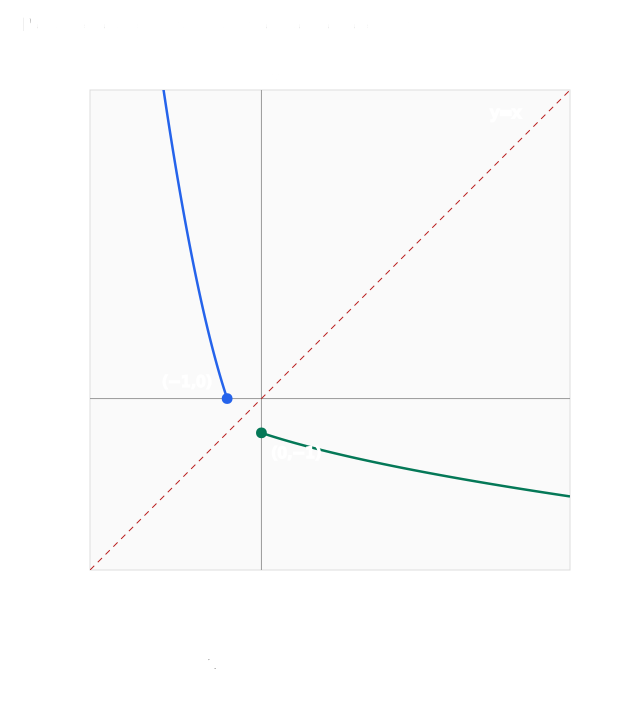
Reflect in : has intercept ; has intercept .
Sketch only for , with closed endpoint and no y-intercept. Reflect every point across to obtain on , starting at closed and decreasing. It has no x-intercept because all outputs are at most −1. Draw and use equal axis scales to make the reflection explicit. A vertical axis marked x in the source sketch is a label slip; the reconstruction uses y.
Expand diagramFit diagram to page
Use the scrollbars or arrow keys to inspect details.
(iii) State where the identity holds
Answer
.
on the entire original domain of the inner inverse: . The inverse outputs are accepted by . Do not extend the identity beyond this domain.
(iv) Show that the composite exists
Answer
exists on .
. Every inverse output avoids the excluded input 3, so exists on all of .
(iv) Map the exact range
Answer
.
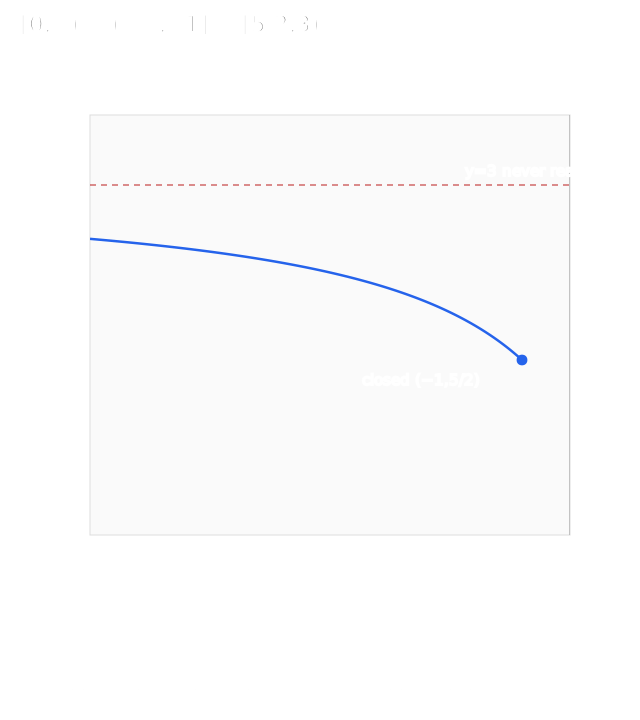
Use the source mapping method: maps through to , then through to . The question asks for the range, so no composite rule is needed. At the included endpoint, . As the intermediate input tends to , approaches 3 from below without reaching it. On the function decreases as t increases; it reaches every output between those bounds. Include 5/2 and exclude 3.
Expand diagramFit diagram to page
Use the scrollbars or arrow keys to inspect details.