Porisma

Worked solution

Follow the order and the reached range

For f(x)=2x+1f(x)=2x+1 and g(x)=x2−3g(x)=x^2-3, both on R\mathbb R, can you find gf(2)gf(2)? Next let f(x)=x2f(x)=x^2 on {3,4,5}\{3,4,5\} and g(x)=x+2g(x)=x+2 on {2,3}\{2,3\}. What is the rule of fgfg? State its domain and range. Finally, state the condition for gfgf to exist.

CJC · Functions · Composition activities

Find gf(2)

Answer

gf(2)=22gf(2)=22.

The preceding worked example gives fg(2)=f(22−3)=f(1)=3fg(2)=f(2^2-3)=f(1)=3. For the reverse order apply ff first: gf(2)=g[f(2)]=g[2(2)+1]=g(5)=52−3=22gf(2)=g[f(2)]=g[2(2)+1]=g(5)=5^2-3=22. The two orders need not agree.

How did this part go?

Define the finite composite

Answer

fg(x)=(x+2)2fg(x)=(x+2)^2, Dfg={2,3}D_{fg}=\{2,3\}, Rfg={16,25}R_{fg}=\{16,25\}.

The inner map sends 2↦42\mapsto4 and 3↦53\mapsto5. These outputs lie in Df={3,4,5}D_f=\{3,4,5\}, so the outer map accepts both. Then 4↦164\mapsto16 and 5↦255\mapsto25. Although the full outer range is Rf={9,16,25}R_f=\{9,16,25\}, the composite never reaches 9: the unused outer input 3 is not in Rg={4,5}R_g=\{4,5\}. Thus the composite range is the reached subset, not the entire outer range.

Expand diagram

Use the scrollbars or arrow keys to inspect details.
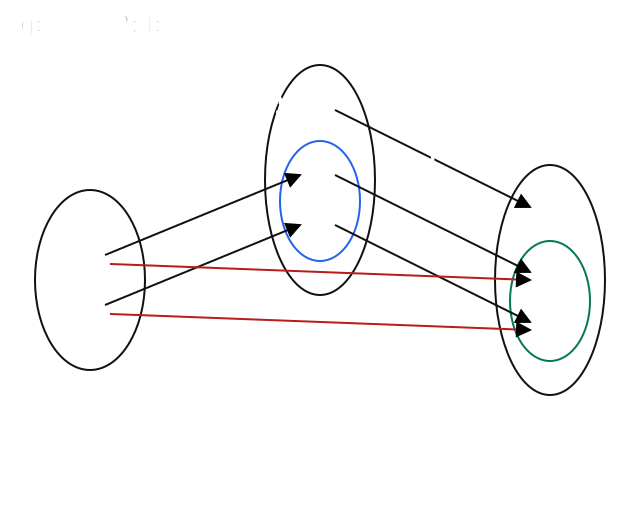
g maps 2 to 4 and 3 to 5, then f maps 4 to 16 and 5 to 25. Outer domain also includes 3 mapping to 9, but these are not reached. Rg={4,5} and Rfg={16,25} are circled subsets of Df and Rf.
How did this part go?

State the condition for gf

Answer

Rf⊆DgR_f\subseteq D_g.

Every output from the first function ff must fit into the next domain DgD_g. The source funnel analogy illustrates successful passage versus spillage: one rejected intermediate output prevents composition on the entire original domain. Funnel widths are schematic; the condition is set inclusion. When it holds, Dgf=DfD_{gf}=D_f.

Expand diagram

Use the scrollbars or arrow keys to inspect details.
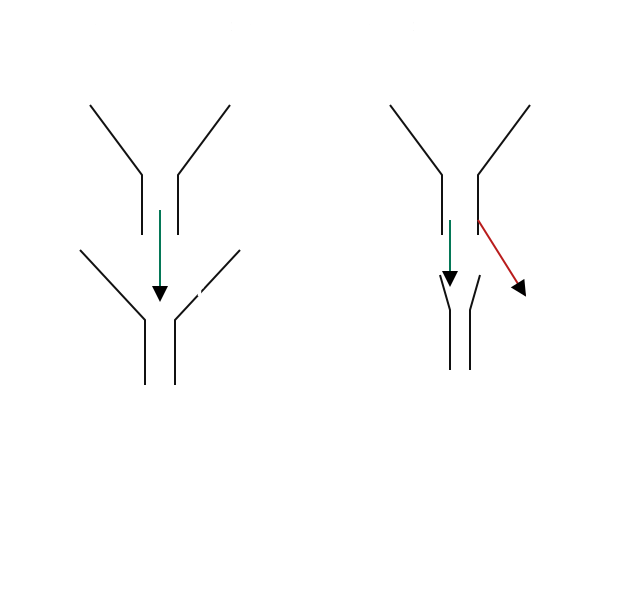
Two stacked funnel pairs represent successful Rg subset Df and failure when some g output spills outside Df. Mouth=domain, neck=range; widths schematic. Reverse gf requires Rf subset Dg.
How did this part go?