Worked solution
Classify the two turning points exactly
Find the coordinates of the turning points of the curve , indicating the nature of each turning point.
CJC · Lecture · Example 4
Differentiate the original quotient
The printed self-reading algebraic method uses the quotient rule:
Retain , where the original curve is undefined.
Solve the stationary-point equation
The source sets , so . Factor to obtain or . Both inputs belong to the domain. Substitution gives and .
Classify using the printed second derivative
Applying the quotient rule again, the source gives
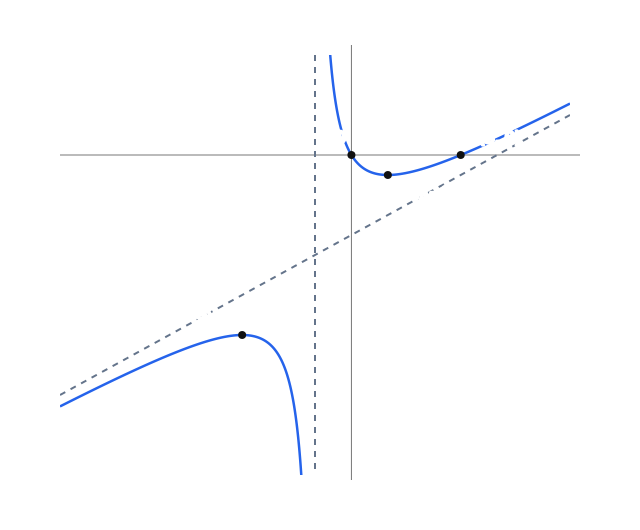
At , and , so is a maximum point. At , and , so is a minimum point. Independently the derivative simplifies to ; these are local extrema on separate branches, not global bounds on the whole curve.
Bracket the maximum with the calculator
The source gives six steps. 1. Enter in Y1. 2. Press 2nd → TRACE to access CALCULATE, then choose 4:maximum. Both copies say “to find the x-intercepts” here; this is a wording slip—the selected routine finds the maximum. 3. Move left of the maximum with the arrows and press ENTER, or enter a left-bound number. The next screen asks for the right bound; the source’s red note marks this transition.
Set the right bound and guess, then verify
- Move right of the maximum and press ENTER, or enter a right-bound number. The source shows the Right Bound? screen before confirming and the Guess? screen afterwards. Its numerical-method remark says to round appropriately and verify the answer. 5. Move close to the maximum for the guess, then press ENTER. The calculator display is approximately ; the exact calculation above verifies it. Independently, keep the bracket on the same continuous branch, away from the vertical asymptote .
Repeat for the minimum and connect the methods
- Repeat the process for the minimum. Use 3:minimum in the displayed CALCULATE menu for that search. The source’s final display and conclusion give minimum , alongside maximum . The following source remark directs exact turning-point calculus to Applications of Differentiation. The reused reconstruction shows the same curve and printed turning-point coordinates; its asymptotes were established in Example 3.
Compare your sketch
Expand diagramFit diagram to page
Use the scrollbars or arrow keys to inspect details.
Common mistakes
A calculator maximum routine finds a turning point, not a root. Verify numerical coordinates and classify each point on its own branch.
Solution notes
Both complete original solutions compared; the calculator routine’s x-intercepts wording is a source slip, qualified in the working. The source points ahead to Applications of Differentiation for exact methods. No printed marks or external attribution.