Worked solution
Use multiplicity to distinguish crossings and contacts
Sketch the following curves, indicating clearly the coordinates of any intersections with the axes and turning points:
(a) .
(b) .
CJC · Lecture · Example 6
Answer
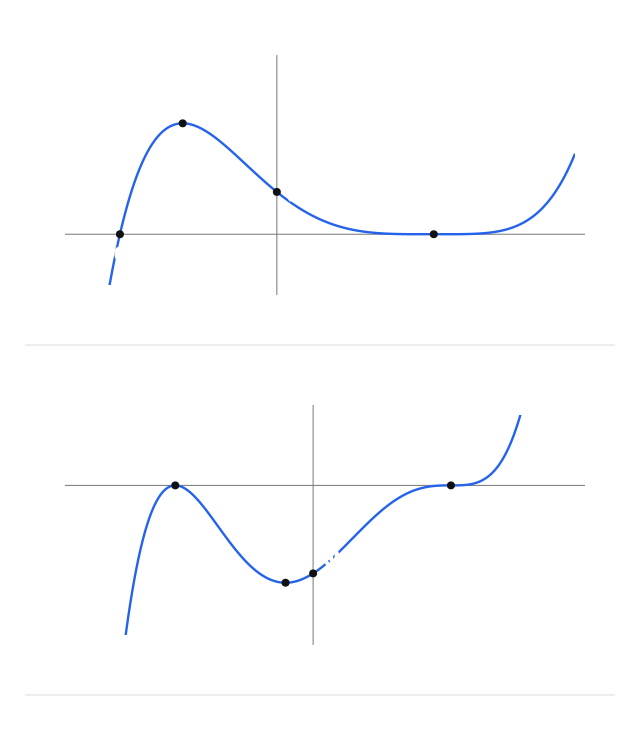
(a) Intercepts , , ; local maximum and local minimum . (b) Intercepts , , ; local maximum and local minimum . At , (b) has a stationary inflection, not a turning point.
(a) Read factors, intercepts and end behaviour
Set each factor to zero: has multiplicity 1 (crossing), while has multiplicity 4 (contact without a sign change). At , . This is a degree-5 polynomial with positive leading coefficient, so its left end goes down and its right end goes up. The Teacher completes the Student’s blank axes with these intercepts and the turning-point label .
(a) Verify both turning points
Independent calculus verifies the source sketch:
The derivative changes at , and at . Thus the maximum is and the minimum is . The Teacher’s is rounded; retain the exact point for calculation.
(b) Reverse the crossing/contact roles
Both copies already print this completed sketch. The even multiplicity 2 gives contact at ; the odd multiplicity 3 gives a crossing at . The -intercept is . Again the degree is 5 with positive leading coefficient. The printed lower turning point is .
(b) Separate a stationary inflection from a turn
Independent calculus gives
The derivative changes at (local maximum), then at (local minimum). Its exact lower point is , agreeing with the source’s rounded ordinate. At the squared derivative factor leaves the sign positive on both sides, so the curve crosses with a horizontal tangent and does not turn. Locally has a nonzero cubic leading term about , giving a stationary inflection.
Compare your sketch
Expand diagramFit diagram to page
Use the scrollbars or arrow keys to inspect details.
Common mistakes
A zero derivative does not by itself prove a turning point. The two polynomials exchange which root crosses and which root touches.
Solution notes
Teacher Example 6(a) supplies the curve and coordinates absent from the visible Student axes. Example 6(b) is already drawn in both. Exact derivative checks are additional teaching, not printed source working. No printed marks or external attribution.