Porisma

Worked solution

Approximate a triangular area inside a square

The diagram shows a square ABCD of side AB=a cm. E is the point on BC such that angle CAE=θ\theta. Show that the area of △ACE\triangle ACE is tan⁡θ1+tan⁡θa2\dfrac{\tan\theta}{1+\tan\theta}a^2.

If θ\theta is sufficiently small for θ3\theta^3 and higher powers of θ\theta to be neglected, show that area⁡(△ACE)≈a2θ(1−θ)\operatorname{area}(\triangle ACE)\approx a^2\theta(1-\theta).

Expand diagram

Use the scrollbars or arrow keys to inspect details.
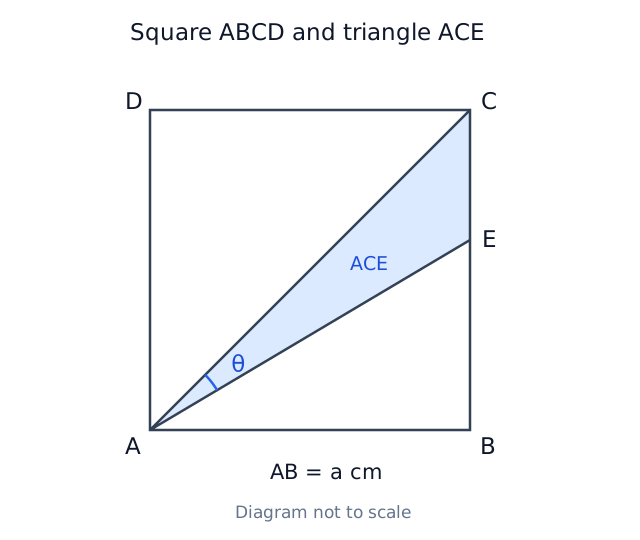
Square ABCD with A bottom left, B bottom right, C top right and D top left, AB=a cm. E lies on BC below C. Segments AC and AE enclose angle θ at A. The shaded triangle ACE is the difference between right triangles ABC and ABE. Diagram not to scale.

CJC · Lecture · Example 11

Subtract two right-triangle areas

Student PDF 25 is blank apart from its header/footer, and its complete printed solution follows on PDF 26 (printed 92), matching Teacher PDF 25 (printed 91). Both copies begin with

area⁡(ACE)=area⁡(ABC)−area⁡(ABE),area⁡(ABC)=12a2.\operatorname{area}(ACE)=\operatorname{area}(ABC)-\operatorname{area}(ABE),\qquad \operatorname{area}(ABC)=\frac12a^2.

Since AC is a diagonal of the square, ∠BAE=π/4−θ\angle BAE=\pi/4-\theta. Work with a>0 and E on BC; for an interior E, 0<θ<π/40<\theta<\pi/4.

How did this part go?

Use the full tangent subtraction identity to find BE

The shared callout gives tan⁡(A−B)=(tan⁡A−tan⁡B)/(1+tan⁡Atan⁡B)\tan(A-B)=(\tan A-\tan B)/(1+\tan A\tan B). Its complete application is

BEAB=tan⁡(π/4−θ)=tan⁡(π/4)−tan⁡θ1+tan⁡(π/4)tan⁡θ=1−tan⁡θ1+tan⁡θ.\begin{aligned}&\frac{BE}{AB}\\ & =\tan(\pi/4-\theta)\\ & =\frac{\tan(\pi/4)-\tan\theta}{1+\tan(\pi/4)\tan\theta}\\ & =\frac{1-\tan\theta}{1+\tan\theta}.\end{aligned}

Hence BE=AB(1−tan⁡θ)/(1+tan⁡θ)BE=AB(1-\tan\theta)/(1+\tan\theta), and

area⁡(ABE)=12(AB)(BE)=12(a)(1−tan⁡θ1+tan⁡θa)=12a21−tan⁡θ1+tan⁡θ.\begin{aligned}&\operatorname{area}(ABE)\\ & =\frac12(AB)(BE)\\ & =\frac12(a)\left(\frac{1-\tan\theta}{1+\tan\theta}a\right)\\ & =\frac12a^2\frac{1-\tan\theta}{1+\tan\theta}.\end{aligned}

How did this part go?

Simplify the exact area before approximating

The complete printed subtraction chain is

area⁡(ACE)=12a2−12a21−tan⁡θ1+tan⁡θ=12a2(1−1−tan⁡θ1+tan⁡θ)\begin{aligned}&\operatorname{area}(ACE)\\ & =\frac12a^2-\frac12a^2\frac{1-\tan\theta}{1+\tan\theta}\\ & =\frac12a^2\left(1-\frac{1-\tan\theta}{1+\tan\theta}\right)\end{aligned}

=12a2(1+tan⁡θ)−(1−tan⁡θ)1+tan⁡θ=tan⁡θ1+tan⁡θa2,=\frac12a^2\frac{(1+\tan\theta)-(1-\tan\theta)}{1+\tan\theta}=\frac{\tan\theta}{1+\tan\theta}a^2,

as required. These equalities are exact, and the area is in square centimetres.

How did this part go?

Use the small angle and a reciprocal series

Both copies apply tan⁡θ≈θ\tan\theta\approx\theta in radians and explicitly recommends a negative exponent for the denominator:

area⁡(ACE)≈θ1+θa2=a2θ(1+θ)−1\begin{aligned}&\operatorname{area}(ACE)\approx\frac{\theta}{1+\theta}a^2\\ & =a^2\theta(1+\theta)^{-1}\end{aligned}

=a2θ[1+(−1)θ+⋯ ]≈a2θ(1−θ).=a^2\theta[1+(-1)\theta+\cdots]\approx\boxed{a^2\theta(1-\theta)}.

Because the expression has an outer θ, retaining the reciprocal bracket through its linear term supplies every required term through θ². The standard binomial callout is the same coefficient formula used earlier in the chapter.

How did this part go?

Common mistakes

The diagonal makes π/4 with AB, so the relevant right-triangle angle is π/4−θ; subtract its area before applying a small-angle approximation.

Solution notes

Both original diagrams and complete solutions visually compared: Student solution PDF 26/printed 92 matches Teacher PDF 25/printed 91; StudentPDF 25 is a real extra blank page, not an extraction failure. Full tangent-subtraction, area and reciprocal-series working/callouts are common to both copies. No marks or attribution.

Read the hint