Maclaurin series and approximation
Practice section 3 of 7
Questions 13–18 in this collection
Practice questions
Worked example · 1 of 6
Track the order of an approximation through division
If is sufficiently small for and higher powers of to be neglected, find approximations for
(a) ,
(b) .
CJC · Lecture · Example 10
Solution
Self-practice · 2 of 6
Normalize a square root before using the binomial series
If is sufficiently small for and higher powers of to be neglected, find an approximation for .
CJC · Lecture · Self-Practice 4
Solution
Worked example · 3 of 6
Approximate a triangular area inside a square
The diagram shows a square ABCD of side AB=a cm. E is the point on BC such that angle CAE=. Show that the area of is .
If is sufficiently small for and higher powers of to be neglected, show that .
Expand diagramFit diagram to page
Use the scrollbars or arrow keys to inspect details.
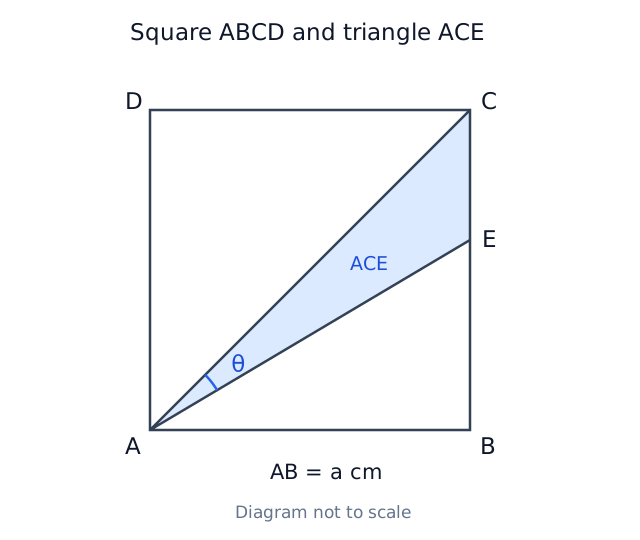
CJC · Lecture · Example 11
Solution
Discussion practice · 4 of 6
Remove the first two exponential-series terms
Using MF27, find the sum , giving your answer in terms of .
CJC · Discussion · Question 1
Solution
Discussion practice · 5 of 6
Track coefficients in a composite binomial
In the expansion of , the coefficient of is . Find and the coefficient of .
CJC · Discussion · Question 2
Solution
Discussion practice · 6 of 6
Expand a rational function using partial fractions
Express in partial fractions. Hence obtain its expansion in ascending powers of up to and including . Find also the range of values of for which the expansion is valid.
[2012/SRJC/Promo/5]
CJC · Discussion · Question 3