Worked solution
Distinguish two children from twice one child
In a country, men’s weights are normal with mean 70 kg and variance 18 kg², and children’s weights are normal with mean 30 kg and variance 9 kg². The weights of men and children are independent. Find the probability that
(i) a randomly selected man weighs more than two randomly selected children combined,
(ii) a randomly selected man weighs more than twice one randomly selected child. A certain HDB lift has maximum load 340 kg:
(iii) find the probability it is overloaded by 3 men and 4 children;
(iv) find the smallest a such that the probability that the average weight of three randomly chosen men exceeds a kg is less than 0.7.
CJC · Lecture · Example 8
Define the observations and independence model
Let and in kg. Use separate indexed variables for different people. The source calculations assume independently selected individuals, including the two children and three men; cross-group independence alone would not establish those within-group assumptions.
(i) Two separately selected children
. Thus to three significant figures. The Teacher fills this distribution and probability in the Student working space.
(ii) Twice one selected child
. Hence to three significant figures. This variance 54 differs from 36 in(i).
(iii) The lift overload event
. The overload probability is to three significant figures.
(iv) Obtain the strict cutoff
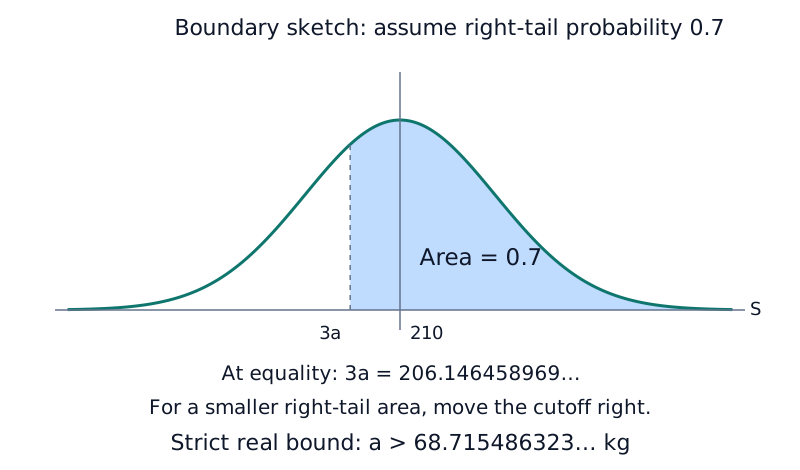
Put . Then is . First assume equality as in the Teacher sketch: , giving . Since the right-tail probability strictly decreases as its cutoff increases, the required inequality is , or . This monotonicity explains the Teacher’s lecturer note to demonstrate the inequality.
(iv) Qualify the requested smallest value
The Teacher gives . This is the allowable set on a one-decimal grid, whose smallest member is 68.8 kg; the source prompt does not explicitly specify that grid. Among unrestricted real values there is no smallest a, only the infimum 68.715486323…kg, excluded by the strict inequality. The native Student extraction contains a hidden line while its rendered working space is blank;68.7 itself does not satisfy the probability requirement. Keep the exact inequality rather than rounding its boundary down.
Compare your sketch
Expand diagramFit diagram to page
Use the scrollbars or arrow keys to inspect details.
Common mistakes
The second parameter is variance. A strict probability inequality has an open real cutoff; a rounded displayed number is not automatically the smallest admissible real value.