Porisma

Worked solution

Synchronise projectile flight with an approaching target

(Self-reading)

A cannonball is fired from O at speed v metres per second and angle θ∘\theta^\circ above the ground. At time t seconds, x=(vcos⁡θ)tx=(v\cos\theta)t, y=(vsin⁡θ)t−5t2y=(v\sin\theta)t-5t^2, where x and y are horizontal and vertical displacement in metres.

(i) Find its horizontal range d when it hits the ground, in terms of v and theta.

Use v=200v=200 for the remaining parts. A target approaches O along the ground at 10 metres per second, initially 3000 metres away when the cannonball is fired. Neglect the target height.

(ii) Show the possible firing angles to hit it are 22.7∘22.7^\circ and 69.5∘69.5^\circ.

(iii) Explain which angle hits it earlier.

Expand diagram

Use the scrollbars or arrow keys to inspect details.
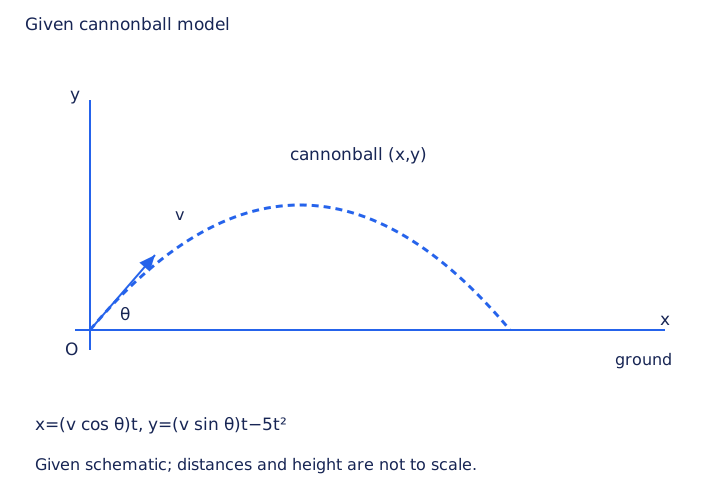
Given setup: cannonball launched from origin O with velocity v at angle theta above the ground; dashed arch shows its trajectory and a point is labelled (x,y). Horizontal x and vertical y axes are shown. Not to scale.

[2017/DHS/I/10i, ii]

CJC · Lecture · Example 7

(i) Use the nonzero landing time

y=0y=0 gives t(vsin⁡θ−5t)=0t(v\sin\theta-5t)=0. Rejecting the launch instant, T=vsin⁡θ/5T=v\sin\theta/5. The range is d=(vcos⁡θ)T=v2sin⁡θcos⁡θ/5d=(v\cos\theta)T=v^2\sin\theta\cos\theta/5, for a physical launch angle between 0 and 90 degrees.

How did this part go?

(ii) Equate the target and projectile times

The target travels 3000−d3000-d at speed 10, so vsin⁡θ/5=(3000−d)/10v\sin\theta/5=(3000-d)/10. Hence 2vsin⁡θ=3000−v2sin⁡θcos⁡θ/52v\sin\theta=3000-v^2\sin\theta\cos\theta/5. With v=200v=200, this is 8000sin⁡θcos⁡θ+400sin⁡θ=30008000\sin\theta\cos\theta+400\sin\theta=3000. Solving in degrees on 0<θ<90∘0<\theta<90^\circ gives approximately 22.7∘22.7^\circ or 69.5∘69.5^\circ (1 d.p.), as printed.

How did this part go?

(iii) Compare the flight times

T=40sin⁡θT=40\sin\theta seconds. Sine is increasing on this physical angle interval, so 40sin⁡22.7∘<40sin⁡69.5∘40\sin22.7^\circ<40\sin69.5^\circ. Choose 22.7∘22.7^\circ to hit the target earlier. The initial range alone does not decide the flight time.

How did this part go?

Compare your sketch

Expand diagram

Use the scrollbars or arrow keys to inspect details.
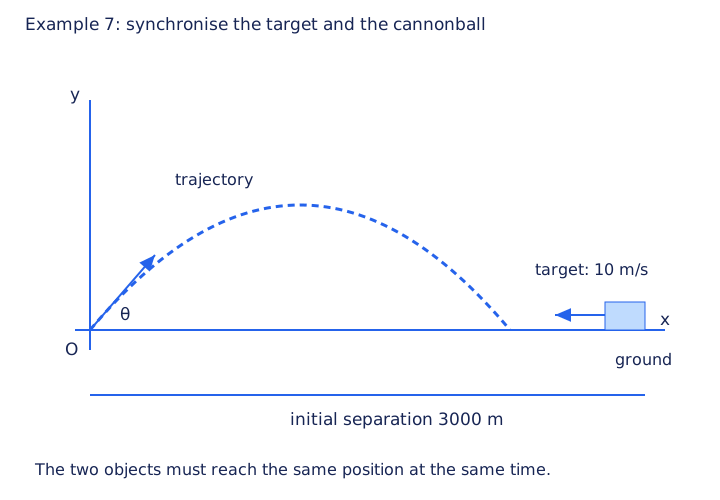
Schematic of a cannonball trajectory from O toward an approaching ground target, showing target speed 10 metres per second, initial separation 3000 metres, firing angle theta and the common landing position.

Common mistakes

Do not use t=0 as the landing time, or treat the moving target as a stationary point 3000 metres away.

Read the hint