Parametric equations
Practice section 2 of 6
Questions 7–12 in this collection
Practice questions
Worked example · 1 of 6
Synchronise projectile flight with an approaching target
(Self-reading)
A cannonball is fired from O at speed v metres per second and angle above the ground. At time t seconds, , , where x and y are horizontal and vertical displacement in metres.
(i) Find its horizontal range d when it hits the ground, in terms of v and theta.
Use for the remaining parts. A target approaches O along the ground at 10 metres per second, initially 3000 metres away when the cannonball is fired. Neglect the target height.
(ii) Show the possible firing angles to hit it are and .
(iii) Explain which angle hits it earlier.
Expand diagramFit diagram to page
Use the scrollbars or arrow keys to inspect details.
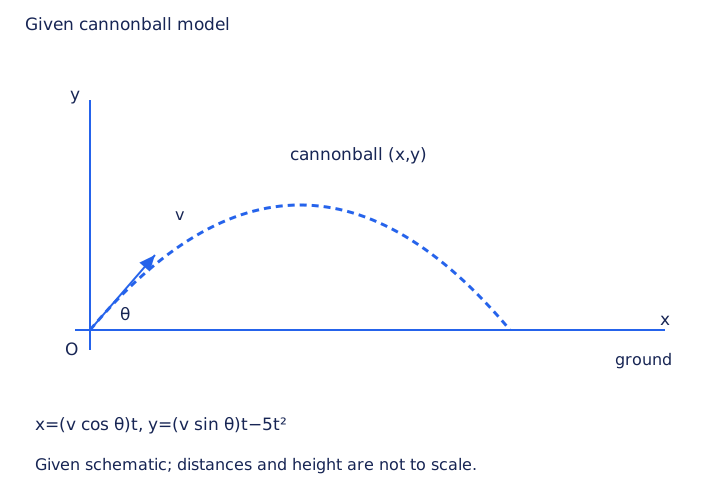
[2017/DHS/I/10i, ii]
CJC · Lecture · Example 7
Solution
Worked example · 2 of 6
Divide parameter derivatives to obtain the Cartesian gradient
For , , find in terms of t and hence the point where the gradient is 1.
CJC · Lecture · Example 8
Solution
Self-practice · 3 of 6
Practise reciprocal and trigonometric derivative ratios
Find in terms of t for (a) , ; (b) , .
CJC · Lecture · Self-Practice 1
Solution
Worked example · 4 of 6
Find tangent and normal equations with a scale parameter
For , , where a is constant and , (i) find the normal at ; (ii) find the tangent at .
CJC · Lecture · Example 9
Solution
Worked example · 5 of 6
Trace a moving midpoint locus from tangent intercepts
For , :
(i) Find and simplify the tangent equation at .
(ii) Hence find Q and R where that tangent meets the x- and y-axes, respectively.
(iii) Find a Cartesian equation for the locus of the midpoint of QR as p varies.
[2011/9740/I/3]
CJC · Lecture · Example 10
Solution
Worked example · 6 of 6
Find a normal and distinguish its second curve intersection
For , , show the normal at is . It meets the curve again at Q; find t at Q.
[2006//PJC/II/3]
CJC · Lecture · Example 11