Worked solution
Rearrange the ACE icon with repeated symbols
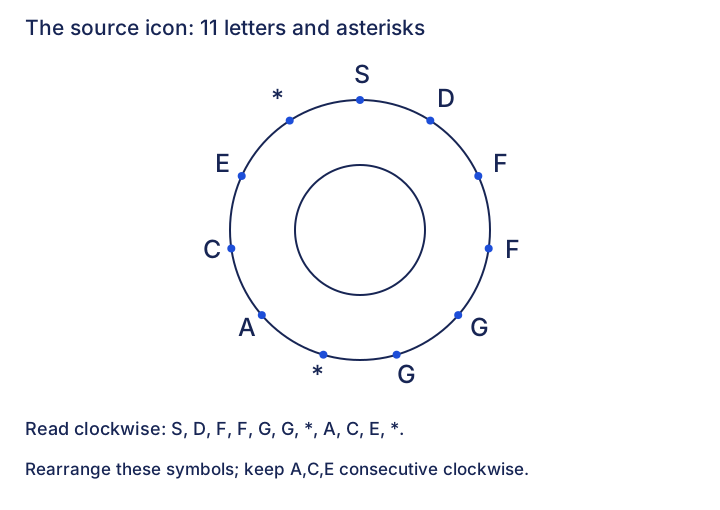
A student wishes to re-arrange the letters and asterisks on the icon shown. Given that the letters of the word ACE must be together in the clockwise manner, find the number of possible arrangements if (i) the asterisks must be separated, (ii) the positions of the letters and asterisks are labelled.
Expand diagramFit diagram to page
Use the scrollbars or arrow keys to inspect details.
CJC · Lecture · Example 19
Inventory the symbols and fix the block order
There is one each of A,C,E,S,D, two F copies, two G copies and two asterisks: 11 symbols. Treat consecutive clockwise A,C,E as one block. This block has only one allowed internal order; do not multiply by 3! or 2!.
(i) Arrange the seven non-asterisk objects
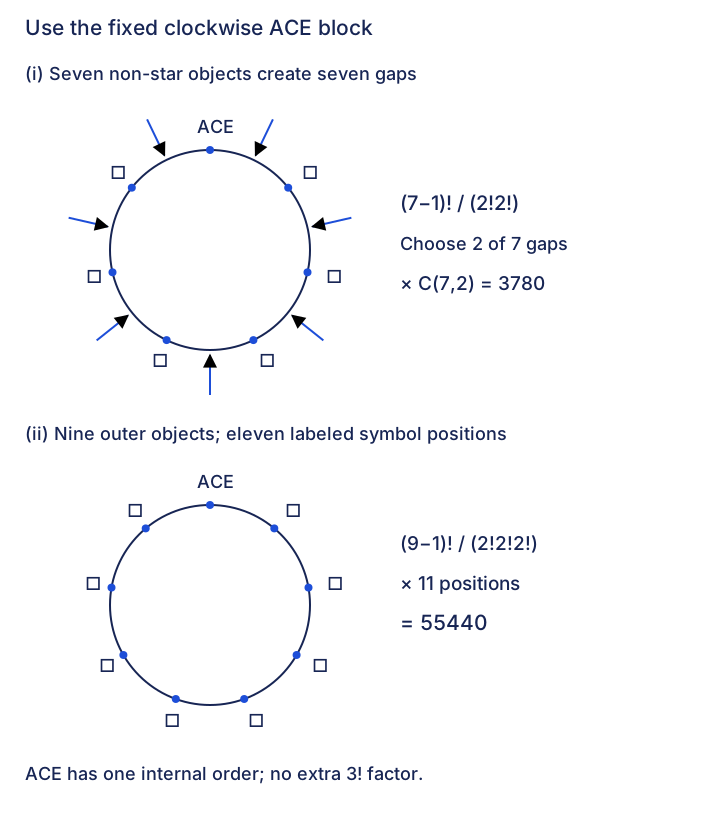
The ACE block,S,D,F,F,G,G are seven objects. Fix the unique ACE block as a circular reference and arrange the other six, correcting for two identical F copies and two identical G copies: .
(i) Choose two different gaps
Those seven circular objects create seven gaps, including the gaps immediately before and after the ACE block but none inside it. Put the two identical asterisks in two different gaps, giving choices. Total .
(ii) Include both asterisks among nine outer objects
Part (ii) is a separate condition; it does not retain the separation requirement of part (i). The ACE block and eight remaining symbols give nine outer objects. Fix ACE as a reference and correct for pairs of F,G and asterisks: circular arrangements.
(ii) Restore the eleven labeled symbol positions
There are 11 choices for the labeled position occupied by A, which fixes the clockwise ACE block and anchors the circular order. Hence . Use 11 original symbol positions, not nine compressed objects; ACE occupies three consecutive positions and may wrap across the label boundary.
Compare your sketch
Expand diagramFit diagram to page
Use the scrollbars or arrow keys to inspect details.
Common mistakes
Do not permute the letters inside ACE. Part (i) uses unlabelled positions with separated asterisks; part (ii) uses labelled positions without that extra separation restriction. Repeated copies require the stated divisors. The unique ACE block anchors the rotational count, avoiding an unjustified general division rule for arbitrary repeated circular objects.