Permutations and combinations
Practice section 5 of 10
Questions 25–30 in this collection
Practice questions
Worked example · 1 of 6
Rearrange the ACE icon with repeated symbols
A student wishes to re-arrange the letters and asterisks on the icon shown. Given that the letters of the word ACE must be together in the clockwise manner, find the number of possible arrangements if (i) the asterisks must be separated, (ii) the positions of the letters and asterisks are labelled.
Expand diagramFit diagram to page
Use the scrollbars or arrow keys to inspect details.
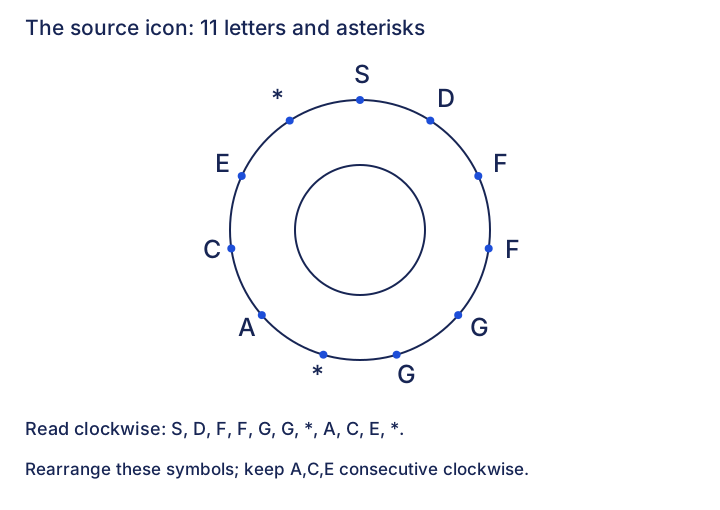
CJC · Lecture · Example 19
Solution
Self-practice · 2 of 6
Seat ten people with two couples
A group of ten people consists of four single women, two single men and 2 couples. The ten people are seated randomly in a circle. Find the number of arrangements if (i) there is no restriction, (ii) the couples must seat together, (iii) the seats are of different colours.
CJC · Lecture · Self-Practice 6
Solution
Discussion practice · 3 of 6
Count numbers by their number of digits
Given the digits 1, 2, 3, 4, 6 and 8, and using each digit at most once, determine how many numbers can be formed if the number has to be
(i) less than 100,
(ii) between 100 and 1000,
(iii) between 1000 and 10000.
CJC · Discussion · Question 1
Solution
Discussion practice · 4 of 6
Count possible phone numbers before excluding the correct one
A girl wishes to phone a friend but cannot remember the exact number. She knows that it is a five-digit number, that it is even, and that it consists of the digits 2, 3, 4, 5 and 6 in some order. Using this information, find the largest number of different wrong telephone numbers she could try.
[2002/I/17(b)]
CJC · Discussion · Question 2
Solution
Discussion practice · 5 of 6
Divide by permutations of indistinguishable groups
Find the number of ways in which 6 people may be divided into groups of
(i) 1, 2 and 3,
(ii) 2, 2 and 2,
(iii) 3, 1, 1 and 1.
CJC · Discussion · Question 3
Solution
Discussion practice · 6 of 6
Choose letters and then account for their order
A four-letter word can be formed from any of the 26 letters in the alphabet. Determine the number of such words with
(i) repetitions of the letters allowed,
(ii) different letters and containing exactly one vowel,
(iii) repetitions allowed and containing at least one vowel.
CJC · Discussion · Question 4