Worked solution
Relate an exponential recurrence to its two fixed points
The graph is , whose roots are .
(i) Find both roots to 3 decimal places.
A real sequence satisfies for .
(ii) Prove algebraically that, if it converges, its limit is or .
(iii) Use a calculator to determine its behaviour for .
(iv) By considering , prove that if , and if or .
(v) Relate (iv) to the behaviours in (iii).
Expand diagramFit diagram to page
Use the scrollbars or arrow keys to inspect details.
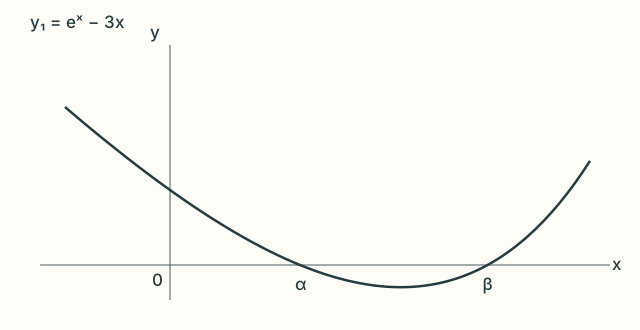
[2007/I/9]
CJC · Sequences and Series · Example 32
(i) Two roots
Answer
(3 d.p.).
Solve the graph equation on both sides of its minimum
The calculator root values are ordered by alpha<beta. The positive y-intercept and one minimum give two positive crossings.
(ii) Possible limits under the convergence assumption
Answer
If the sequence converges to a finite , then or .
State the hypothesis before replacing terms by limits
The source callout stresses that convergence is assumed here. The shifted sequence has the same limit, and the exponential is continuous.
Recognise the root equation
This identifies possible limits; it does not establish convergence for every initial value.
(iii) Calculator behaviours
Answer
For , it increases to ; for , it decreases to ; for , it increases and diverges to positive infinity.
Iterate using unrounded values
The source table displays rounded early values. Repeated 0.619 entries are a display precision effect, not exact equality with the limit.
Compare the three starts with the two roots
The source reports increasing convergence from 0, decreasing convergence from 1, and increasing divergence from 2. The sign argument and interval reasoning in (iv)–(v) justify these observed patterns.
(iv) Sign of the successive difference
Answer
between the roots, and outside them.
Express the difference as a positive rescaling of the given graph
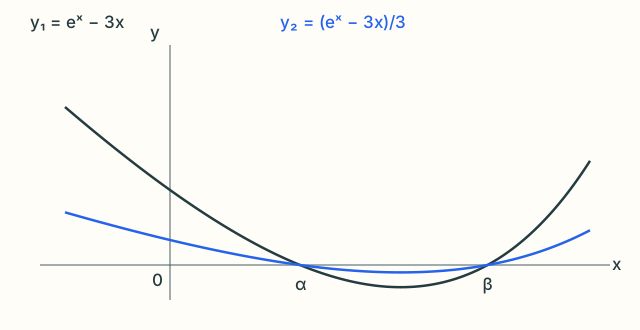
The source suggests entering y2=(e^x−3x)/3 on the calculator with y1=e^x−3x. Dividing vertical coordinates by 3 preserves roots and signs.
Use the negative region between the roots
The graph is below the axis between alpha and beta.
Use the positive regions outside the roots
The graph is above the axis outside the two crossings. An algebraic sign check is also available: h″(x)=e^x>0 and h′(x)=e^x−3 has its only zero at ln3, so h decreases to one minimum then increases.
Expand diagramFit diagram to page
Use the scrollbars or arrow keys to inspect details.
(v) Explain the three observed behaviours
Answer
gives increase; gives decrease; gives increase. The first two converge to and the third is unbounded.
Keep later iterates in the same relevant interval
The source compares the three initial values with the roots. To extend each sign statement to every iterate, use that g(x)=e^x/3 is strictly increasing and fixes both roots.
Distinguish bounded increase from unbounded increase
Starts 0 and 1 are monotone and bounded on the appropriate side of alpha, so their finite limits must be alpha. Starting at 2 gives an increasing sequence always at least 2; any finite limit would exceed beta and contradict (ii), so it diverges to positive infinity.
Solution notes
The source rounds roots and limit displays to 0.619 and 1.512; these are approximations, not exact roots. Its final sentence in (ii) must retain the initial “if convergent” hypothesis. Interval preservation and the boundedness argument in (v) are authored details that justify applying the source sign test repeatedly.