Sequences and series
Practice section 9 of 17
Questions 49–54 in this collection
Practice questions
Worked example · 1 of 6
Split an infinite GP into equal prefix and tail sums
In an infinite geometric progression with a nonzero first term and common ratio , the sum of the first terms equals the sum of all the remaining terms. Find .
[Adapted from SMO 2016 Open Section Round 1 Q2]
CJC · Sequences and Series · Example 28
Solution
Worked example · 2 of 6
Combine polynomial and geometric finite sums
Given and , evaluate: (a) ; (b) in terms of (and ); (c) .
CJC · Sequences and Series · Example 29
Solution
Worked example · 3 of 6
Unfold a geese-population recurrence in two directions
A poultry farmer raises chickens, ducks and geese. Allowing for conditions such as sales and deaths from infection, the geese population at the end of months is modelled by , with and initial population . Calculate for (i) and (ii) , commenting briefly on the results. Find in terms of ; deduce that for large , and use the formula to justify the earlier comments.
[Adapted from MEI Structured Mathematics, Pure Mathematics 2, 2001 June Exam Paper 2602/1, Q1(modified)]
CJC · Sequences and Series · Example 30
Solution
Worked example · 4 of 6
Fit an exponential-linear recurrence and sum its terms
A sequence satisfies for , where is constant.
(i) Given , find and .
Its nth term has the form , where are constants.
(ii) Find .
(iii) Find in terms of ; you need not simplify your answer.
[2008/I/8]
CJC · Sequences and Series · Example 31 (Self-Reading)
Solution
Worked example · 5 of 6
Relate an exponential recurrence to its two fixed points
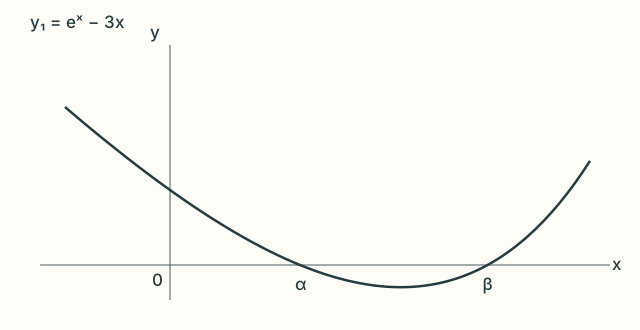
The graph is , whose roots are .
(i) Find both roots to 3 decimal places.
A real sequence satisfies for .
(ii) Prove algebraically that, if it converges, its limit is or .
(iii) Use a calculator to determine its behaviour for .
(iv) By considering , prove that if , and if or .
(v) Relate (iv) to the behaviours in (iii).
Expand diagramFit diagram to page
Use the scrollbars or arrow keys to inspect details.
[2007/I/9]
CJC · Sequences and Series · Example 32
Solution
Worked example · 6 of 6
Use an AP of sector areas and a GP condition
A radius- circle is cut into unequal sectors with areas in arithmetic progression. The first and smallest has area , followed by square units. Show that . If the first, fourth and ninth sector areas are consecutive GP terms, show that . Hence find the area of the largest sector.
[2010/CJC/Promo/7(b)(modified)]
CJC · Sequences and Series · Example 33 (Self-Reading)