Porisma

Worked solution

Reciprocate three supplied sketches

Given the three graphs of y=f(x)y=f(x), sketch the corresponding graphs of y=1/f(x)y=1/f(x). Indicate, if possible, the coordinates of the turning points, axial intercepts and asymptotes.

Expand diagram

Use the scrollbars or arrow keys to inspect details.
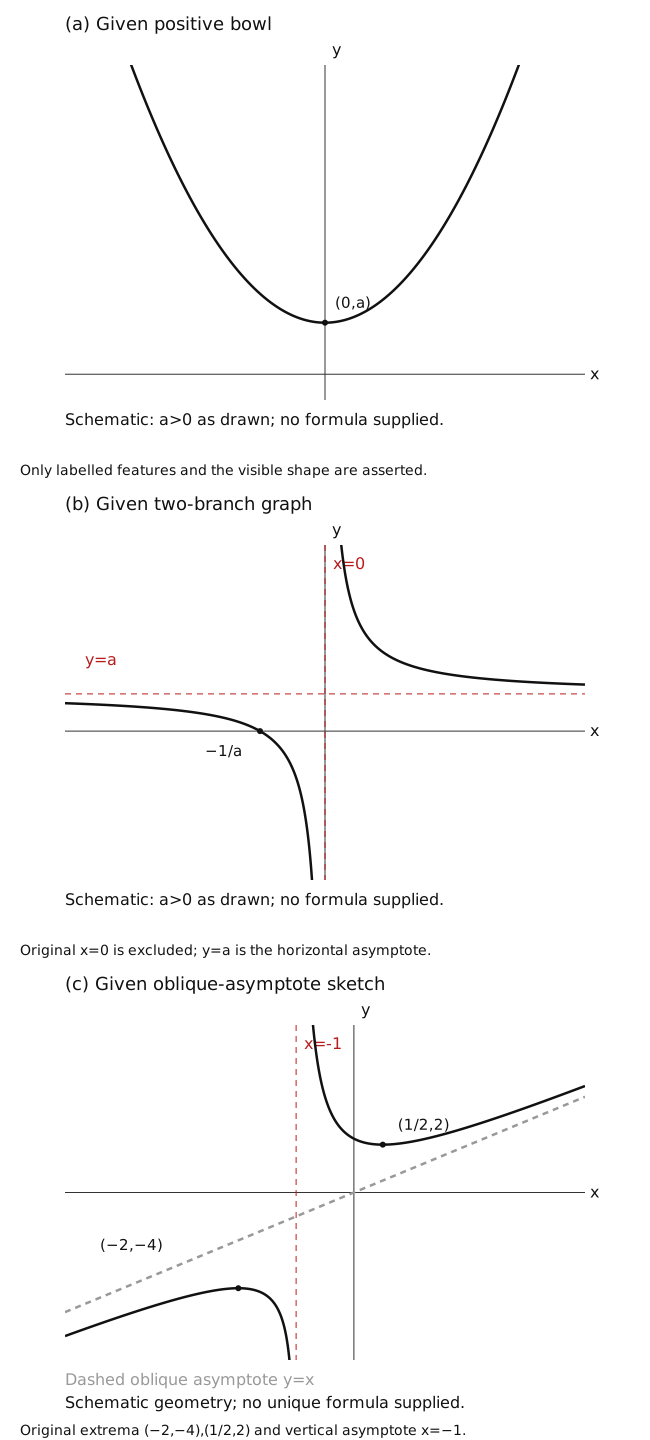
Three given schematic graphs. (a) Positive bowl, minimum (0,a). (b) Horizontal asymptote y=a, vertical x=0, root −1/a, a>0 as drawn. (c) Pole x=−1, oblique y=x, local maximum (−2,−4) and local minimum (1/2,2). No unique formula for any graph is supplied.

CJC · Transformations · Example 17

(a) Reciprocate the positive bowl

Answer

Local maximum and y-intercept (0,1/a)(0,1/a); horizontal asymptote y=0y=0.

The given bowl has minimum (0,a)(0,a) with a>0a>0 as drawn, no zeros, and outputs growing without bound at both ends. Its reciprocal stays positive, has no x-intercepts or vertical asymptotes, and tends to zero at both ends. No unique formula for the given curve is inferred.

Expand diagram

Use the scrollbars or arrow keys to inspect details.
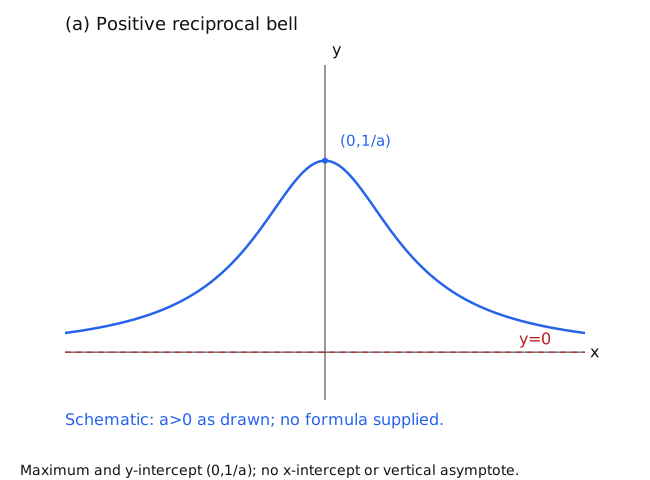
Given positive bowl with minimum (0,a), and its positive reciprocal bell with maximum (0,1/a), horizontal asymptote y=0 and no x-intercept. Schematic a>0; no formula supplied.
How did this part go?

(b) Keep the excluded origin

Answer

Vertical asymptote x=−1/ax=-1/a; horizontal asymptote y=1/ay=1/a; a hole at (0,0)(0,0).

The given graph has horizontal asymptote y=ay=a, vertical asymptote x=0x=0 and root x=−1/ax=-1/a, with a>0a>0 as drawn. The root produces the reciprocal pole; the finite non-zero horizontal limit is inverted. The original domain excludes 0, so the reciprocal also excludes 0 even though both one-sided limits there are 0. The source labels (0,0)(0,0) and draws the curve through it; retain that printed claim in the native/review evidence and show an open hole in the mathematical sketch. There are no actual axial intercepts. No turning point is indicated.

Expand diagram

Use the scrollbars or arrow keys to inspect details.
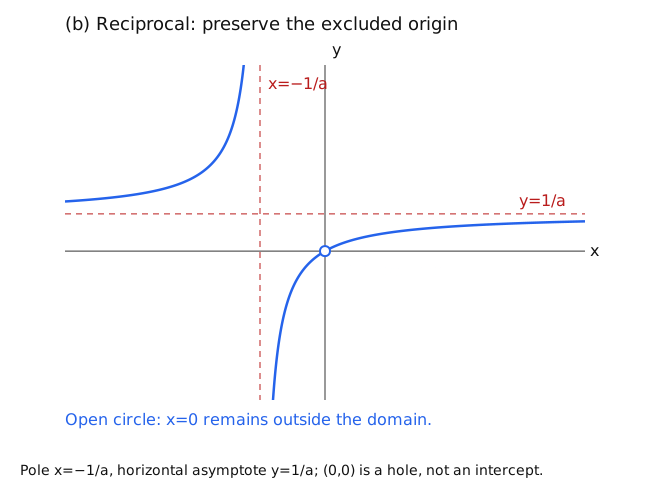
Given schematic rational curve, horizontal asymptote y=a, vertical x=0, root −1/a. Reciprocal has vertical asymptote −1/a, horizontal 1/a and an open hole at (0,0), rather than the filled origin suggested by the source.
How did this part go?

(c) Transform non-zero turning points and the oblique limit

Answer

Local minimum (−2,−1/4)(-2,-1/4); local maximum (1/2,1/2)(1/2,1/2); horizontal asymptote y=0y=0 and a hole at (−1,0)(-1,0).

The given sketch has local maximum (−2,−4)(-2,-4), local minimum (1/2,2)(1/2,2), vertical asymptote x=−1x=-1 and oblique asymptote y=xy=x. Invert the non-zero turning-point heights. At either infinite end, f grows in magnitude along its oblique asymptote, so the reciprocal tends to 0. At the excluded input −1 the reciprocal tends to 0 but remains undefined; the source label (−1,0)(-1,0) is a limit location, not an actual x-intercept. No zero of f is drawn, so no reciprocal vertical asymptote is indicated. The numerical y-intercept cannot be determined from the labelled features alone; no unique formula is inferred.

Expand diagram

Use the scrollbars or arrow keys to inspect details.
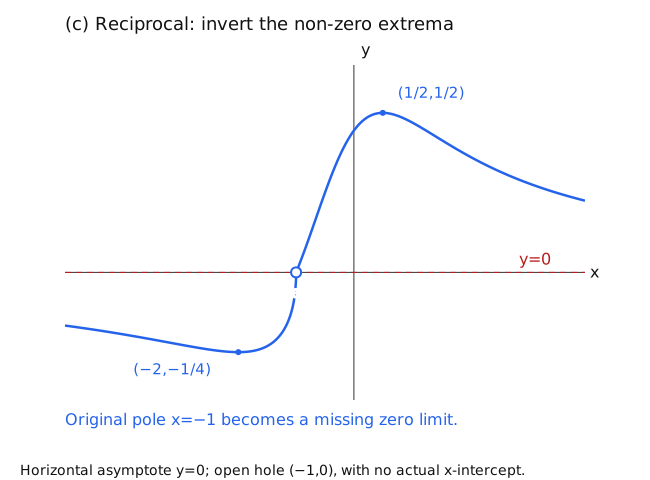
Given schematic curve with pole x=−1, oblique y=x, extrema (−2,−4),(1/2,2). Reciprocal has extrema (−2,−1/4),(1/2,1/2), horizontal asymptote y=0 and an open hole at (−1,0), with no asserted numeric y-intercept.
How did this part go?