Porisma
All chapter practice

Graph transformations

Practice section 6 of 9

Questions 31–36 in this collection

Practice questions

Worked example · 1 of 6

Compare curves with their reciprocals

Use a graphing calculator to sketch (a)(i) y=x+2y=x+2, (ii) y=1/(x+2)y=1/(x+2); (b)(i) y=(x+1)(x−3)y=(x+1)(x-3), (ii) y=1/((x+1)(x−3))y=1/((x+1)(x-3)). By comparing each pair, what do you observe about the relationship between y=f(x)y=f(x) and y=1/f(x)y=1/f(x)?

CJC · Transformations · Reciprocal activity

Solution

Worked example · 2 of 6

Reciprocate three supplied sketches

Given the three graphs of y=f(x)y=f(x), sketch the corresponding graphs of y=1/f(x)y=1/f(x). Indicate, if possible, the coordinates of the turning points, axial intercepts and asymptotes.

Expand diagram

Use the scrollbars or arrow keys to inspect details.
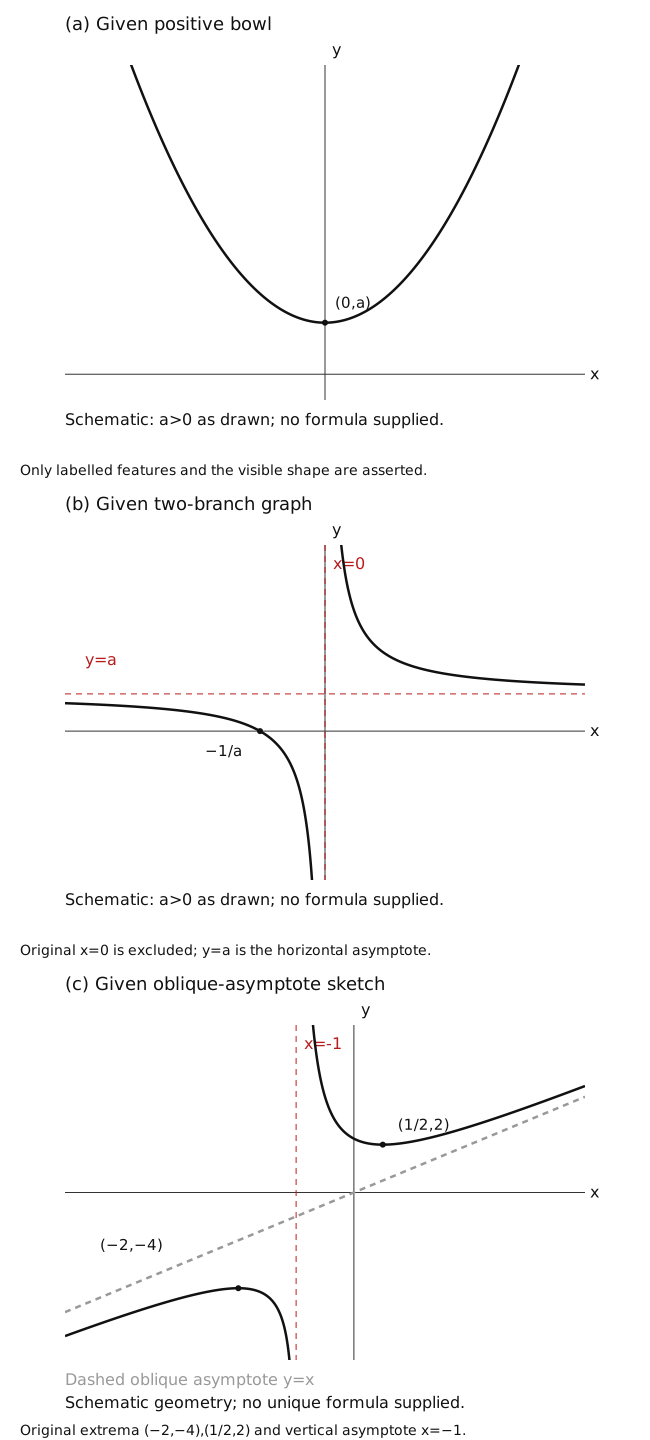
Three given schematic graphs. (a) Positive bowl, minimum (0,a). (b) Horizontal asymptote y=a, vertical x=0, root −1/a, a>0 as drawn. (c) Pole x=−1, oblique y=x, local maximum (−2,−4) and local minimum (1/2,2). No unique formula for any graph is supplied.

CJC · Transformations · Example 17

Solution

Worked example · 3 of 6

Reciprocate a sketch with an excluded vertical limit

The curve shown has equation y=f(x)y=f(x). On a separate diagram, sketch y=1/f(x)y=1/f(x), indicating clearly the asymptotes and the coordinates of points corresponding to A(3,−1)A(3,-1) and B(1,0)B(1,0) where applicable.

Expand diagram

Use the scrollbars or arrow keys to inspect details.
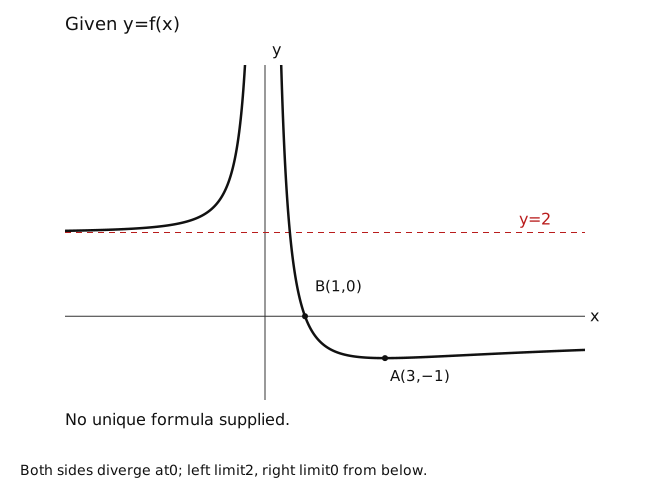
Given schematic y=f(x): left horizontal asymptote y=2, divergence upwards on both sides of x=0, root B(1,0), minimum A(3,−1), and right branch approaching y=0 from below. No formula is supplied.

CJC · Transformations · Example 18

Solution

Worked example · 5 of 6

Track five labelled points through eight transformations

The graph of y=f(x)y=f(x) is shown, with A(−1,0)A(-1,0), B(−0.549,−0.631)B(-0.549,-0.631), C(0,0)C(0,0), D(1.215,2.113)D(1.215,2.113) and E(2,0)E(2,0). On separate diagrams, sketch (a) y=f(x−2)y=f(x-2), (b) y=f(−x)+1y=f(-x)+1, (c) y=f(2x+1)y=f(2x+1), (d) y=2f(∣x∣)y=2f(|x|), (e) y=f(−∣x∣)y=f(-|x|), (f) y=∣f(x−2)∣y=|f(x-2)|, (g) y=f(∣x−2∣)y=f(|x-2|), (h) y=1/f(x)y=1/f(x). Indicate clearly, if possible, all coordinates of points corresponding to A, B, C, D and E.

Expand diagram

Use the scrollbars or arrow keys to inspect details.
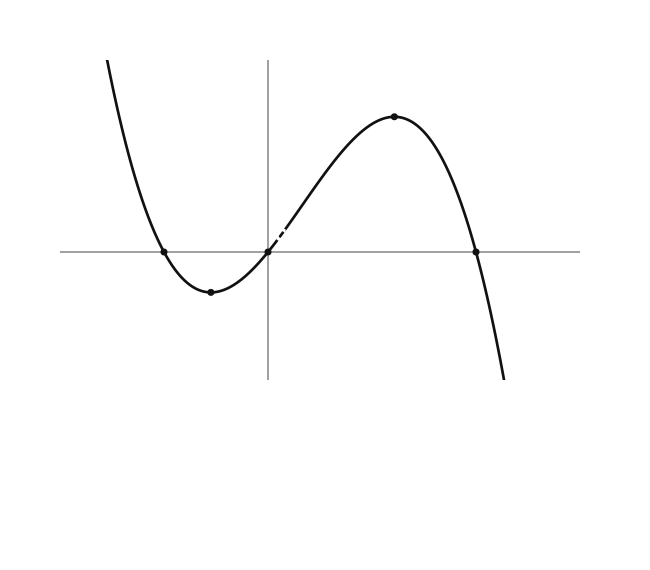
Given cubic-like graph with A(−1,0), B(−0.549,−0.631) local minimum, C(0,0), D(1.215,2.113) local maximum and E(2,0). Left tail rises and right tail falls. B/D are printed approximate data; no unique formula supplied.

CJC · Transformations · Example 19

Solution

Discussion practice · 6 of 6

Keep the order of horizontal translation and scaling

Explain how the graph of y=2/(3x−1)y=2/(3x-1) may be obtained from y=1/xy=1/x by appropriate transformations.

CJC · Discussion · Question 1

Solution

Back to all practice questions