Porisma

Worked solution

Reciprocate a sketch with an excluded vertical limit

The curve shown has equation y=f(x)y=f(x). On a separate diagram, sketch y=1/f(x)y=1/f(x), indicating clearly the asymptotes and the coordinates of points corresponding to A(3,−1)A(3,-1) and B(1,0)B(1,0) where applicable.

Expand diagram

Use the scrollbars or arrow keys to inspect details.
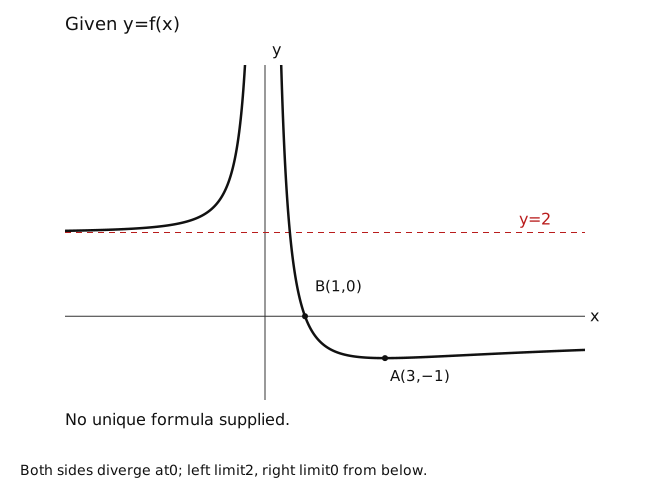
Given schematic y=f(x): left horizontal asymptote y=2, divergence upwards on both sides of x=0, root B(1,0), minimum A(3,−1), and right branch approaching y=0 from below. No formula is supplied.

CJC · Transformations · Example 18

Map the labelled points and limits

Answer

A↦A′(3,−1)A\mapsto A\prime(3,-1); BB produces vertical asymptote x=1x=1; left horizontal asymptote y=1/2y=1/2.

The given curve tends to 2 at the left infinite end, diverges at x=0x=0, crosses at B and has minimum A before tending to 0 from below at the right infinite end. A is unchanged because 1/(−1)=−11/(-1)=-1, but becomes a reciprocal maximum. B has no finite corresponding point because division by 0 is undefined. The left limit 2 becomes 1/2; the right zero limit makes the reciprocal unbounded, rather than creating a right horizontal asymptote.

How did this part go?

Sketch with the original domain exclusion

Answer

The origin is an open hole; the only indicated vertical asymptote is x=1x=1.

The Teacher fills the blank Student answer axes, labelling y=1/2y=1/2, x=1x=1 and A′(3,−1)A\prime(3,-1). Both original sides diverge upwards near 0; the reciprocal tends to 0 from above on both sides. Preserve the exclusion at 0. The source draws a filled origin, following its table convention; this is qualified as a hole without an explicitly defined extension. Preserve the negative branch to the right of 1 and its maximum at A′. No unique formula or unknown intercept is inferred.

Expand diagram

Use the scrollbars or arrow keys to inspect details.
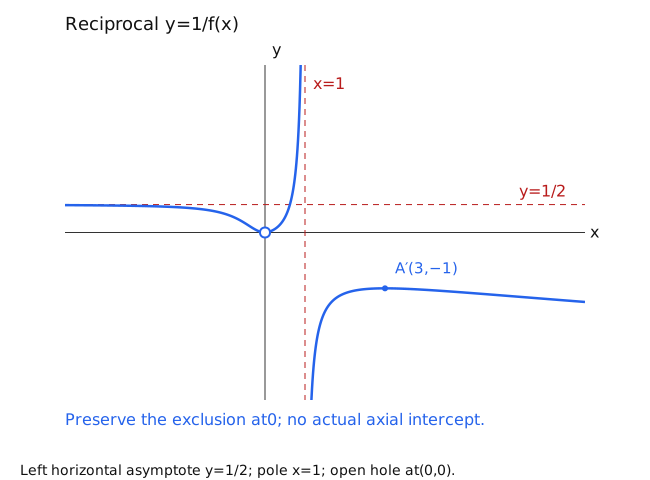
Given curve has left horizontal limit 2, vertical divergence at 0, root B(1,0), minimum A(3,−1), right limit 0 from below. Reciprocal has left horizontal asymptote 1/2, pole 1, open hole (0,0), unchanged A′(3,−1) as a maximum, and unbounded negative right tail.
How did this part go?