Worked solution
Compare curves with their reciprocals
Use a graphing calculator to sketch (a)(i) , (ii) ; (b)(i) , (ii) . By comparing each pair, what do you observe about the relationship between and ?
CJC · Transformations · Reciprocal activity
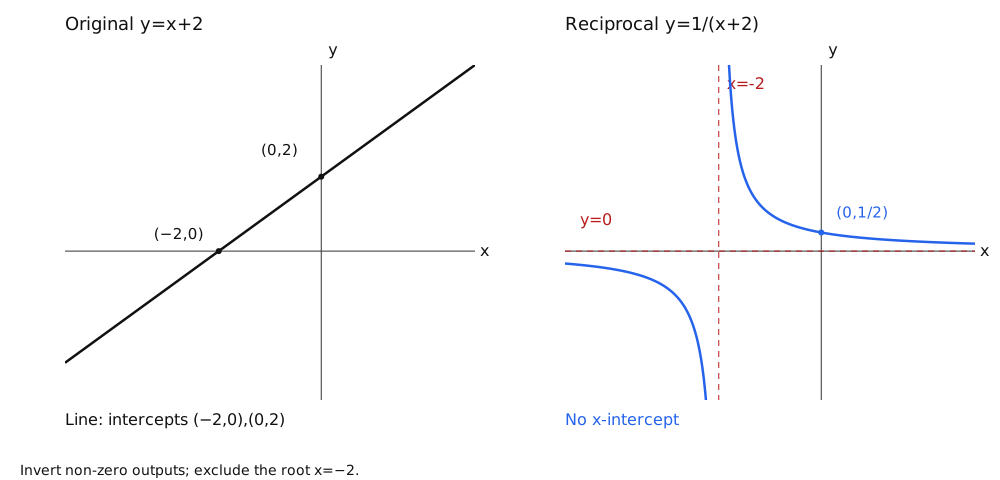
(a) Sketch the line and its reciprocal
Answer
The reciprocal has asymptotes , and y-intercept .
The original line has intercepts and . The Teacher fills the blank Student reciprocal axes. Invert each non-zero output, preserving its sign; exclude . The reciprocal has no x-intercept.
Expand diagramFit diagram to page
Use the scrollbars or arrow keys to inspect details.
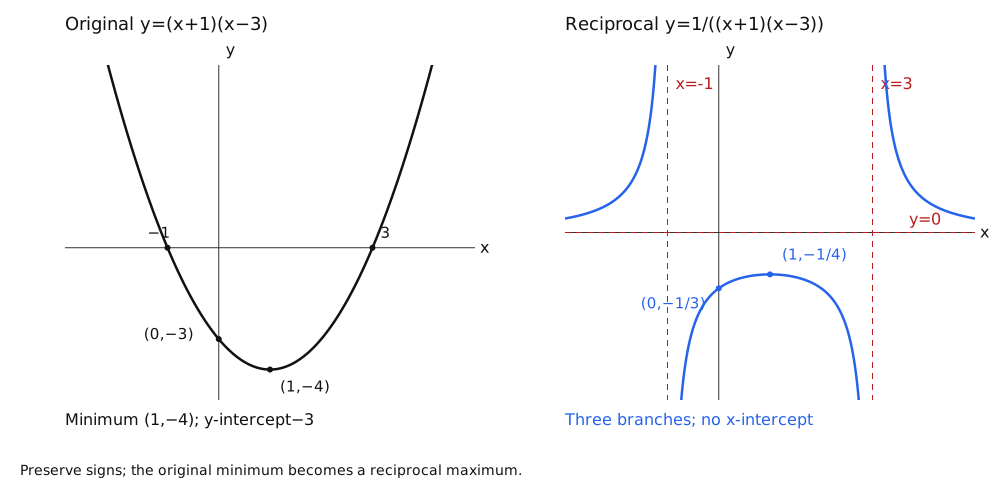
(b) Sketch the quadratic and its reciprocal
Answer
The reciprocal has asymptotes , , ; y-intercept and local maximum .
The original roots are , y-intercept is and minimum is . The Teacher completes the reciprocal graph with all these transformed labels. Preserve three branches: positive outside the roots, negative between them. The negative original minimum becomes a negative reciprocal maximum.
Expand diagramFit diagram to page
Use the scrollbars or arrow keys to inspect details.
Compare signs, extrema and excluded inputs
Answer
for ; preserve the original domain exclusions.
The full source table continues on PDF 23. Signs stay the same, and increasing/decreasing behaviour reverses on each interval where f is continuous and non-zero. Non-zero local maxima/minima become minima/maxima; intersections of the original and reciprocal occur at . A zero is excluded and gives a vertical asymptote when the nearby values tend to zero. The source calls zero limits at original vertical asymptotes “x-intercepts”; this needs qualification: excluded inputs remain holes, not actual intercepts, unless an extension is explicitly defined. The source sidebar contrasts reciprocal shape changes with translations/scalings; non-zero affine scaling preserves the number of turning points, but not necessarily metric shape or the original position of a symmetry axis.