Porisma

Worked solution

Find an intersection by comparing independent coefficients

Nonzero, nonparallel vectors a,b\mathbf a,\mathbf b are the position vectors of A,BA,B relative to OO. PP is the midpoint of ABAB and QQ is the midpoint of OPOP. The line AQAQ produced cuts OBOB at RR. Find, in terms of a,b\mathbf a,\mathbf b, (i) the position vector of QQ relative to OO and (ii) AQ→\overrightarrow{AQ}. Prove that OR→=13b\overrightarrow{OR}=\tfrac13\mathbf b and find AQ:QRAQ:QR.

CJC · Vectors Basic · Example 7

(i) Position of Q

Answer

OQ→=14a+14b\overrightarrow{OQ}=\tfrac14\mathbf a+\tfrac14\mathbf b.

Take two successive midpoints

OP→=a+b2,OQ→=12OP→=14a+14b\overrightarrow{OP}=\frac{\mathbf a+\mathbf b}2,\qquad\overrightarrow{OQ}=\frac12\overrightarrow{OP}=\frac14\mathbf a+\frac14\mathbf b

First average A and B; then halve OP.

How did this part go?

(ii) Displacement AQ

Answer

AQ→=−34a+14b\overrightarrow{AQ}=-\tfrac34\mathbf a+\tfrac14\mathbf b.

Subtract the starting position

AQ→=OQ→−OA→=14a+14b−a=−34a+14b\begin{aligned}&\overrightarrow{AQ}\\ & =\overrightarrow{OQ}-\overrightarrow{OA}\\ & =\frac14\mathbf a+\frac14\mathbf b-\mathbf a\\ & =-\frac34\mathbf a+\frac14\mathbf b\end{aligned}

AQ starts at A, not at the origin.

How did this part go?

Intersection on OB

Answer

OR→=13b\overrightarrow{OR}=\tfrac13\mathbf b.

Describe both lines at R

OR→=kb,AR→=λAQ→=−3λ4a+λ4b\overrightarrow{OR}=k\mathbf b,\qquad\overrightarrow{AR}=\lambda\overrightarrow{AQ}=-\frac{3\lambda}4\mathbf a+\frac\lambda4\mathbf b

R on OB gives OR=k b. R on AQ produced gives AR=λ AQ, with λ>1 checked after solving.

Follow O to A to R

OR→=OA→+AR→=(1−3λ4)a+λ4b=kb\begin{aligned}&\overrightarrow{OR}\\ & =\overrightarrow{OA}+\overrightarrow{AR}\\ & =\left(1-\frac{3\lambda}4\right)\mathbf a+\frac\lambda4\mathbf b\\ & =k\mathbf b\end{aligned}

The two expressions refer to the same point and the same origin.

Use nonparallel directions

0=1−3λ4,k=λ4⟹λ=43,k=130=1-\frac{3\lambda}4,\qquad k=\frac\lambda4\quad\Longrightarrow\quad\lambda=\frac43,\quad k=\frac13

Nonzero, nonparallel a,b make the coefficients unique. Match the a coefficient to zero and the b coefficient to k.

How did this part go?

Ratio AQ:QR

Answer

AQ:QR=3:1AQ:QR=3:1.

Separate the whole AR from the remainder QR

AQ:QR=1:(43−1)=3:1AQ:QR=1:\left(\frac43-1\right)=3:1

AR=(4/3)AQ, so QR=AR−AQ=(1/3)AQ. The positive remainder confirms R is beyond Q.

How did this part go?

Compare your sketch

Expand diagram

Use the scrollbars or arrow keys to inspect details.
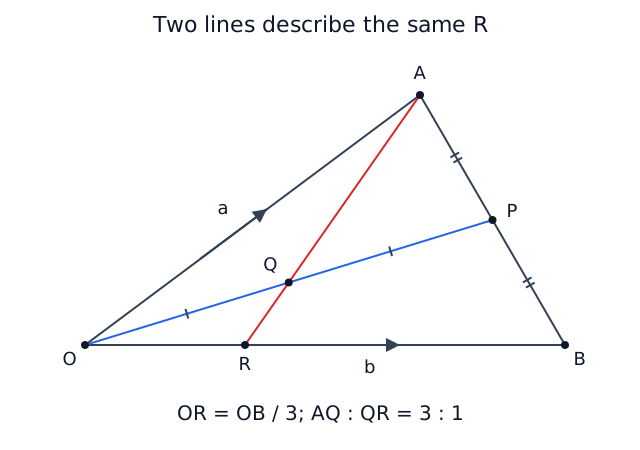
Triangle OAB: P is the midpoint of AB, Q the midpoint of OP, and A,Q,R are collinear with R on OB. The midpoint tick pairs differ. OA and OB carry directions a and b; OR is one third of OB and AQ:QR is 3:1.

Solution notes

The OR proof and final ratio are additional unnumbered asks following (ii). Full working is printed in both copies.