Porisma

Worked solution

Find a perpendicular foot, shortest distance and reflected point

The point is P=(1,1,−1)P=(1,1,-1) and the line is r=(1,2,3)+λ(1,2,1)\mathbf r=(1,2,3)+\lambda(1,2,1), λ∈R\lambda\in\mathbb R.

(i) Find the coordinates of the foot of the perpendicular from P to the line.

(ii) Deduce the shortest distance from P to the line.

(iii) Find the position vector of the image of P in the line.

CJC · Lecture · Example 23

(i) Method 1: put F on the line and use a zero dot product

Write OF→=(1,2,3)+λ(1,2,1)\overrightarrow{OF}=(1,2,3)+\lambda(1,2,1). Then PF→=OF→−OP→=(λ,1+2λ,4+λ)\overrightarrow{PF}=\overrightarrow{OF}-\overrightarrow{OP}=(\lambda,1+2\lambda,4+\lambda). Since PF is perpendicular to the line, (λ,1+2λ,4+λ)⋅(1,2,1)=0(\lambda,1+2\lambda,4+\lambda)\cdot(1,2,1)=0. Thus λ+2+4λ+4+λ=0\lambda+2+4\lambda+4+\lambda=0, so λ=−1. Substitution gives OF→=(1,2,3)−(1,2,1)=(0,0,2)\overrightarrow{OF}=(1,2,3)-(1,2,1)=(0,0,2) and F=(0,0,2).

How did this part go?

(i) Method 2: project AP onto a unit direction

Choose A=(1,2,3), so AP→=(1,1,−1)−(1,2,3)=(0,−1,−4)\overrightarrow{AP}=(1,1,-1)-(1,2,3)=(0,-1,-4) and m^=(1,2,1)/6\widehat{\mathbf m}=(1,2,1)/\sqrt6. The projection vector is AF→=(AP→⋅m^)m^\overrightarrow{AF}=(\overrightarrow{AP}\cdot\widehat{\mathbf m})\widehat{\mathbf m}. Therefore OF→=OA→+(AP→⋅m^)m^=(1,2,3)+[(−2−4)/6](1,2,1)=(0,0,2)\overrightarrow{OF}=\overrightarrow{OA}+(\overrightarrow{AP}\cdot\widehat{\mathbf m})\widehat{\mathbf m}=(1,2,3)+[(-2-4)/6](1,2,1)=(0,0,2). The negative coefficient places F behind A in the positive m direction; the Teacher sketch is schematic and puts A on the other side of F.

How did this part go?

(ii) Take the magnitude of the perpendicular displacement

With λ=−1, PF→=(−1,1+2(−1),4−1)=(−1,−1,3)\overrightarrow{PF}=(-1,1+2(-1),4-1)=(-1,-1,3). Hence the shortest distance is PF=∣PF→∣=(−1)2+(−1)2+32=11PF=|\overrightarrow{PF}|=\sqrt{(-1)^2+(-1)^2+3^2}=\sqrt{11}.

How did this part go?

(iii) Use F as the midpoint of P and its image

Let the reflected point be P′. Since F is the midpoint of PP′, OF→=12(OP→+OP′→)\overrightarrow{OF}=\tfrac12(\overrightarrow{OP}+\overrightarrow{OP'}). Thus OP′→=2OF→−OP→=2(0,0,2)−(1,1,−1)=(−1,−1,5)\overrightarrow{OP'}=2\overrightarrow{OF}-\overrightarrow{OP}=2(0,0,2)-(1,1,-1)=(-1,-1,5). The two perpendicular segments PF and FP′ have equal length.

How did this part go?

Compare your sketch

Expand diagram

Use the scrollbars or arrow keys to inspect details.
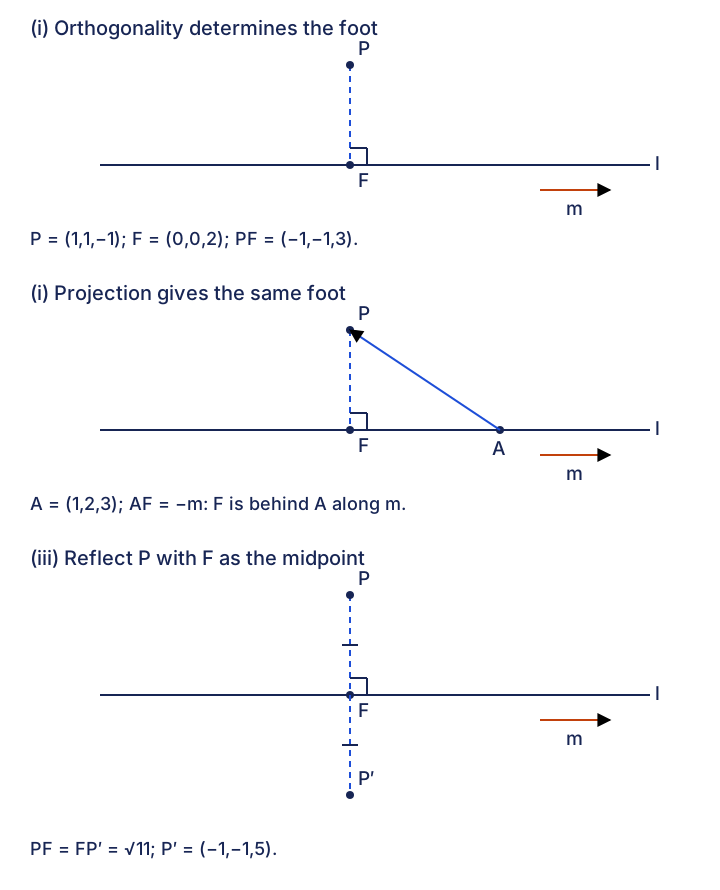
Three worked panels retain the Teacher constructions. P projects to F=(0,0,2); A=(1,2,3) is to the right of F in the direction m=(1,2,1), correcting the source schematic order. Reflecting across the line gives P prime=(-1,-1,5), with F the midpoint and equal perpendicular segments.

Common mistakes

The foot must both lie on the line and make PF perpendicular to its direction. A projection formula needs a unit direction (or division by m·m). Reflection uses 2 f−p, not f−p.

Solution notes

Both source methods and all three Teacher diagrams are incorporated. The projection drawing is corrected to the numerical order F,A; its original schematic placement remains documented in the native record.

Read the hint